

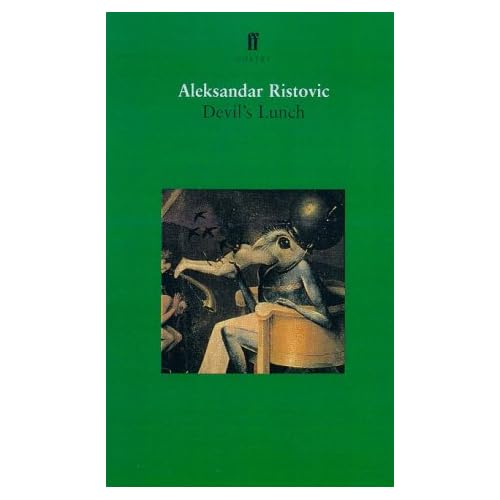
In reviewing Charles Simic’s latest collection for the New York Times, Katha Pollitt briefly (and importantly) mentions his work as a translator of Serbo-Croatian poets, including Vasko Popa and Ivan Lalic. I adore Popa’s work, but am unfamiliar with Lalic’s, beyond the poems Simic included in his anthology of Serbian poets, The Horse Has Six Legs. Another star from this anthology, whose name I don’t often see mentioned (certainly not as frequently as Popa’s) is Aleksandar Ristovi??.
In his introduction to his translation of Ristovi??’s poems, Devil’s Lunch (published by Faber in 1999), Simic writes that “though Ristovi?? published many books of poetry and received three major literary prizes, he has continued to be undeservedly neglected in Yugoslavia. Writers and poets are pack animals, and he, so it appears, did not have the usual ovine instincts. He simply did not belong to any literary movement or clique.” Born in Cacak in 1933, Ristovi?? later moved to Belgrade, where he was an editor of children’s books.
Ristovi??’s poems belong to the same family as Simic’s, often sounding like excerpts from a dark primer to a rustic childhood. (Pollitt also notes, in Simic’s poems, the striking number of chickens. Jonathan Tosch recently reminded me that they are sometimes headless.) “Earthiness” is an adjective often applied to both Simic and Ristovi??, which in the latter’s case manifests partly as a sustained interest in the outhouse. Consider his “Privy,” part of a longer group of poems about lavatories in all their incarnations:
Through a crack on the right
you can see the red rooster,
and through the one on the left,
with a bit of effort,
you can see the table,
the white cloth
and a bottle of wine.
Behind your back, if you turn,
you’ll make out the sheep
trying to fly with their woollen wings.
And through the heart-shaped
hole in the door,
someone’s cheerful face
watching you shit.
Death, too, is everywhere, though as with that cheerful face in “Privy,” even (perhaps especially) mortality strikes Ristovi?? at a humorous angle, which is lucky, considering that he died in 1994. In “Whores,” a sequence of monologues cataloguing a series of peculiar johns (customers, this time, not toilets), Ristovi?? recounts what it’s like to please a skeleton, “At times he loses / some small bone, / so we look for it / among the bedding” and a horse, “With me is a long-legged, / long-eared stallion. / His other horsy virtues / I won’t even mention.”
Along with this comic darkness, Ristovi?? possesses an enormous capacity for tenderness. His poems are full of apostrophes to a much-cared-for “you.” In my favorite piece, “Day-Dreaming in the midst of spring labors,” Ristovi?? momentarily subsumes all his art to the desire to speak to that unknown beloved, of whom I cannot help but feel a part when I read this:
Don’t touch these flowers! Not you who are here,
but you who are over there. Like them,
you are a brainchild of my memory and my hope.
Let the devil himself help you come to me
growing smaller and smaller. I don’t care
about the flowers, which I merely invented
to give myself another reason to address you.
It seems impossible this man could be dead at all, when he calls us to him with such urgency. So let’s say then that he is not, that he merely invented death so he’d have a reason to go on speaking to us, something to write about.