

Ever wonder what they’re reading in Stratford-upon-Avon these days? Here’s a photo from the local W.H. Smith store, the British equivalent of Barnes and Noble:
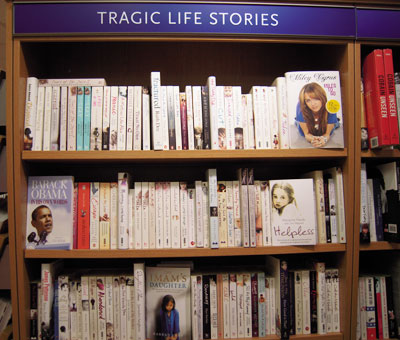
Okay, I know what you’re thinking. Miley Cyrus? On a shelf labeled “Tragic Life Stories?” (Apparently, she still has miles to go. God help us all.) And Barack Obama? (Let’s hope not.) But creative shelving aside, what we’re seeing is marketing in action. The titles say it all: Helpless, Abandoned, Scarred, Ugly, Fractured, Cut, Abandoned“ It’s the latest literary commodity on this side of the Atlantic, the publishing equivalent of the Lifetime channel, with cover graphics ??? pastel colors, titles in script to suggest a cry of pain scrawled on a bathroom mirror in lipstick– that are only a couple Prozac and a credit crisis away from chick-lit. And based simply on bookstore geography, I’m guessing these books sell: this shelf is only a few feet from the checkout counter, so you can grab a copy of Broken or No One Listened while you wait on line.
I don’t mean to dismiss this kind of memoir. I’m sure there’s real pain in the lives narrated here, and no doubt there’s substantial therapeutic value in turning one’s suffering into a survival narrative or in reading about others who have survived. But looking at a shelf like this, I can’t help wincing at the way publishers market these wilted flowers like they’re simply the flip-side of romance novels. Everyone’s pain is deeply personal, but only until you try to squeeze it between the covers of a paperback. After that, it’s a product, and the requirements of the genre dictate that one abuse narrative or struggle with self-loathing quickly blurs into the next. One name for this new literary genre, apparently, is grief porn.
But then, context is everything. Stratford, after all, is a town that knows its tragedy. (Not personally, of course, unless one counts the Black Death and the invention of the Shakespeare tea towel.) Just down the street at the RSC, you can pay to watch King Lear run mad, or Othello sink into jealousy, or Hamlet brood his way into our hearts. What’s different about that? Well, gender, for one thing. Those are explicitly male tragedies, and it takes a conscious effort and a critical will to notice that Lear’s daughters have an arbitrary and irrational father, that Desdemona is the victim of domestic abuse, and that Ophelia. . . well, let’s just say that not every prince is charming. There’s a lingering cultural assumption that when men suffer it’s a deep and apocalyptic pain, while when women suffer, it somehow fits on the same shelf as the autobiography of Miley Cyrus.
What’s troubling about these books is the way they reduce suffering to a brand: those one-word titles push the product, but in a way that feels cynical and mass-produced. Tragedy, for Shakespeare, was a form that asserted radical individuality: his great tragedies, as their titles suggest, bring a single human consciousness into sharp relief. The plays demand that we understand these complex, flawed characters, requiring more of us than empathy or tears. Weeping and outrage are easy responses, like the arousal that porn produces or the sentimentality of romance novels, responses which can be produced as easily as a cash register ringing up sales. But then “tragic life stories” aren’t the same as tragedy, any more than Miley Cyrus is King Lear.