

Earlier this spring I listened to a 13-CD unabridged audio version of Craig Nelson’s mesmerizing biography, Thomas Paine: Enlightenment, Revolution, and the Birth of Modern Nations. I’ve had a thing for Citizen Paine for as long as I can remember. In elementary school, I wrote an essay (my first?) called “Thomas Paine: Brilliance and Common Sense Rolled Up in One.” (I’d pay several hundred dollars to have a copy of the essay — though I’m guessing it would prove less than mesmerizing.) But what did I remember about the facts of Paine’s life, before listening to Nelson’s opus? Sadly, not a lot. Here’s an indisputable fact: Without the aid of Paine’s tremendously persuasive pen, the American colonists may not have found the strength to unshackle themselves from the Brits. Yet Paine is a fuzzy figure at best to most present-day Americans. One of Nelson’s epigraphs comes from Arthur Miller: “There have been so many writers who dominated a period and then slipped off. History is like some gigantic beast — it simply wriggles its back and throws off whatever is on it.”


I spent part of today reading a facsimile of Common Sense that I picked up in Williamsburg, Virginia, a week ago. And with full awareness that my nerd-alert signal is flashing: What fun to read all those f-looking long s‘s! At one point Paine inserts a parenthetical passage — “except in extraordinary cases where the Almighty interposed” — that, in the orthography of 1776, reads, “except in extraordinary cafes where the Almighty interpofed.” Can I tell you how long I’ve been looking for an extraordinary cafe? A page later, Paine writes of the dangers of idolatry, and specifically of a tribe falling into “the same error” — which of course appears as “the fame error.” And what writer hasn’t, at least once, on a deluded night of the soul, fallen into the fame error?
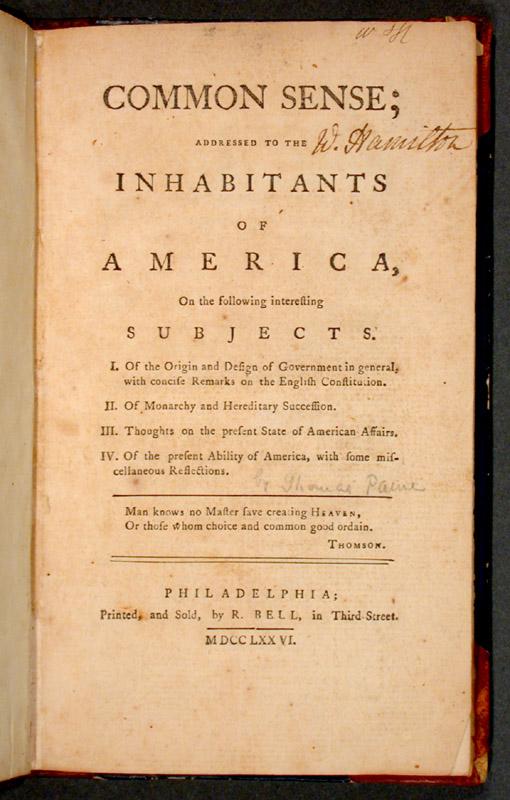


Orthographical amusement aside, Common Sense remains a bracing, provocative read. Paine’s arguments often work by analogy: “And as a man who is attached to a prostitute is unfitted to choose or judge of a wife, so any prepossession in favor of a rotten constitution of government will disable us from discerning a good one.” And later: “As well can the lover forgive the ravisher of his mistress, as the Continent forgive the murders of Britain.” And finally, in the pamphlet’s last line:

These proceedings may at first appear strange and difficult, but, like all other steps which we have already passed over, will in a little time become familiar and agreeable: and until an Independence is declared, the Continent will feel itself like a man who continues putting off some unpleasant business from day to day, yet knows it must be done, hates to set about it, wishes it over, and is continually haunted with the thoughts of its necessity.
Teddy Roosevelt called Paine “a dirty little atheist,” which was wrong on three counts. Like many of the Founding Fathers, Paine was a Deist, and it’s from a Deist perspective that he excoriates, in Common Sense, the idea that rulers are Heaven-sent: “How impious is the title of sacred Majesty applied to a worm, who in the midst of his splendor is crumbling into dust!” He’s equally incensed by the “evil” of hereditary succession. “One of the strongest natural proofs,” he writes, “of the folly of hereditary right in Kings, is, that nature disapproves it, otherwise she would not so frequently turn it into ridicule by giving mankind an Ass for a Lion.” (In this respect, nature’s position remains unchanged. Click here for a funny and unsettling report on Kim Jong-il‘s plans for succession.)


Paine died 200 years ago today. The one-time corset-maker and school teacher was responsible, at least in part, for the success of the American Revolution, the French Revolution, and 19th-century British constitutional reform. He coined the phrase “the United States of America.” He was a gifted inventor — something Thomas Edison pointed out in a lovely tribute. Obama quoted him in his inaugural address. As a friend likes to say: “Hot stuff.”

