

Does it matter where we write our novels and poems and blog posts? I typed my notes for this post in the Berkshire Athenaeum’s Herman Melville Memorial Room in Pittsfield, Massachusetts; I’m now cobbling the notes together in a Seattle Starbucks. Melville wrote much of Moby-Dick on a wooden table in a second-floor study at Arrowhead, his Berkshire home. From his north-facing window, he had a framed view of Mt. Greylock, the tallest point in Massachusetts. Melville loved the mountain; he even dedicated a book to it. It looked, to him, like a whale.


I visited Arrowhead three times this summer. The view from the piazza is marvelous: a field of tall grass and wildflowers, a stand of maples and birches, and Mt. Greylock, surfacing in the distance. In an 1851 letter to Hawthorne, Melville wrote, “I have been ploughing & sowing & raising & printing & praying, and now begin to come out upon a less bristling time, and to enjoy the calm prospect of things from a fair piazza at the north of the old farmhouse here.” Melville lived at Arrowhead from 1850 to 1863; he wrote “Bartleby, the Scrivener” and the other Piazza Tales during his stay, along with Pierre, The Confidence Man, and the final draft of Moby-Dick — which he dedicated to Hawthorne, “in token of my admiration for his genius.” Facing financial difficulties, he sold half of the property in 1856, and then the remainder in 1863, to his brother Allan and moved his family back to New York, where he took a job as a customs inspector. The property stayed in his extended family until 1927; the Berkshire County Historical Society bought it from private owners in 1975.

Upon entering the house, you immediately see the 144-square-foot chimney that Melville celebrated in “I and My Chimney.” (The story begins, “I and my chimney, two grey-headed old smokers, reside in the country. We are, I may say, old settlers here; particularly my old chimney, which settles more and more every day.”) Two Chippendale chairs — made by Thomas Chippendale himself — sit to the left of the fireplace; the parlor features tables for whist, chess, and backgammon, plus a melodion that Melville’s wife Lizzie played. Other curious objects in the house include Oliver Wendell Holmes‘s door chime (Holmes and Melville were neighbors), Mark Twain‘s music stand, and W. E. B. Du Bois‘s childhood chair (which is really, really small).




Herman and Lizzie’s bed rests on ropes; a rope-tightener may be found on the bedside table. (It’s from such contrivances that we get — perhaps — the expression “sleep tight.”) But the house’s sacred spot, of course, is its study, with its Mt. Greylock-facing window that Melville called his “porthole.” Some of his books — with wild annotations: lots of x’s, lots of marginalia — are on display, as is the harpoon-head that he used for a fire-poker. A bust of Shakespeare peers down from a bookshelf. (Melville aspired to “write of real American life with a Shakespearean intensity.”) Two gifts from Hawthorne — a scrimshaw letter opener and an old corkscrew — may also be viewed. (The tour guide on one of my visits raised her eyebrows after pointing out the corkscrew. Contemporaries sometimes accused Melville of being a drunk, or worse. The headline of an 1852 “news story” in the New York Day Book pulled no punches: “HERMAN MELVILLE CRAZY.” The article includes this jaw-dropper: “We hope one of the earliest precautions will be to keep him stringently secluded from pen and ink.”)
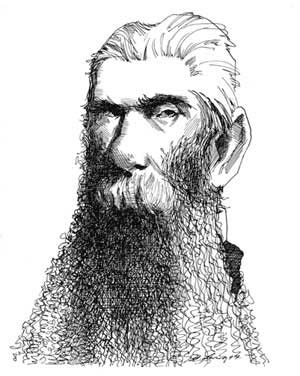
Moby-Dick obsessives will want to supplement a visit to Arrowhead with a stop in the aforementioned Melville Memorial Room, which opened in 1953 and which boasts the world’s largest collection of Melville bric-a-brac. (Think pipes, pocketknives, and pincushions; think thimbles and snuff boxes; think whaling tools, passports, and custom house badges.) In one corner of the room you’ll find the desk on which Melville wrote Billy Budd, along with the breadbox in which Lizzie kept her husband’s manuscripts after his death. The earliest portrait of Melville — by Asa Twitchell of Albany, c. 1848 — hangs above the desk. The room even contains the arrowhead that Melville found on the grounds of his Pittsfield property — the arrowhead for which the estate is named.

Tomorrow marks an important anniversary in the lives of Melville and Hawthorne: it’s the day they met, on an August 5, 1850 hike up Monument Mountain. Had the hike not occurred, and had their friendship not ensued, Melville might not have been so eager to move to the Berkshires. He might never have finished Moby-Dick. American letters would be much diminished and — though it hardly matters — Starbucks wouldn’t be Starbucks.