


September 22nd marks the autumnal equinox for the northern hemisphere. Time to harvest, time to change, time when trees give it all away for free.

- Autumn, Johnson, VT
If you want to know where to go leaf peeping — the U.S. Forest Service offers a toll-free Fall Colors Hotline: 1-800-354-4595. (Reported in warm and slightly world-weary tones by the foliage ladies, and punctuated by odd pauses as if transmitting from space.)
“Nothing gold can stay,” but that does not prevent us from getting in our Buicks and driving slowly along the country roads.
*
Each of us changes in a different way, for different reasons.
Certain colors are characteristic of particular species. Oaks turn red, brown, or russet; hickories, golden bronze; aspen and yellow-poplar, golden yellow; dogwood, purplish red; beech, light tan; and sourwood and black tupelo, crimson. Maples differ species by species — red maple turns brilliant scarlet; sugar maple, orange-red; and black maple, glowing yellow. Striped maple becomes almost colorless. Leaves of some species such as the elms simply shrivel up and fall, exhibiting little color other than drab brown. (Northeastern Area Forest Service)
While changes in temperature (especially variation from warm, sunny days to cool, not-quite-freezing nights), rainfall, air moisture, and regional differences can affect the colors’ intensity and timing.
And it’s not all a loss. Or more accurately, the loss may be necessary, not just to ourselves but to everything around us:
Needles and leaves that fall are not wasted. They decompose and restock the soil with nutrients and make up part of the spongy humus layer of the forest floor that absorbs and holds rainfall. Fallen leaves also become food for numerous soil organisms vital to the forest ecosystem…. It could well be that the forest could no more survive without its annual replenishment from leaves than the individual tree could survive without shedding these leaves. (Northeastern Area Forest Service)
*
Autumn is also a time for revision and regrets, companionship and oatmeal.
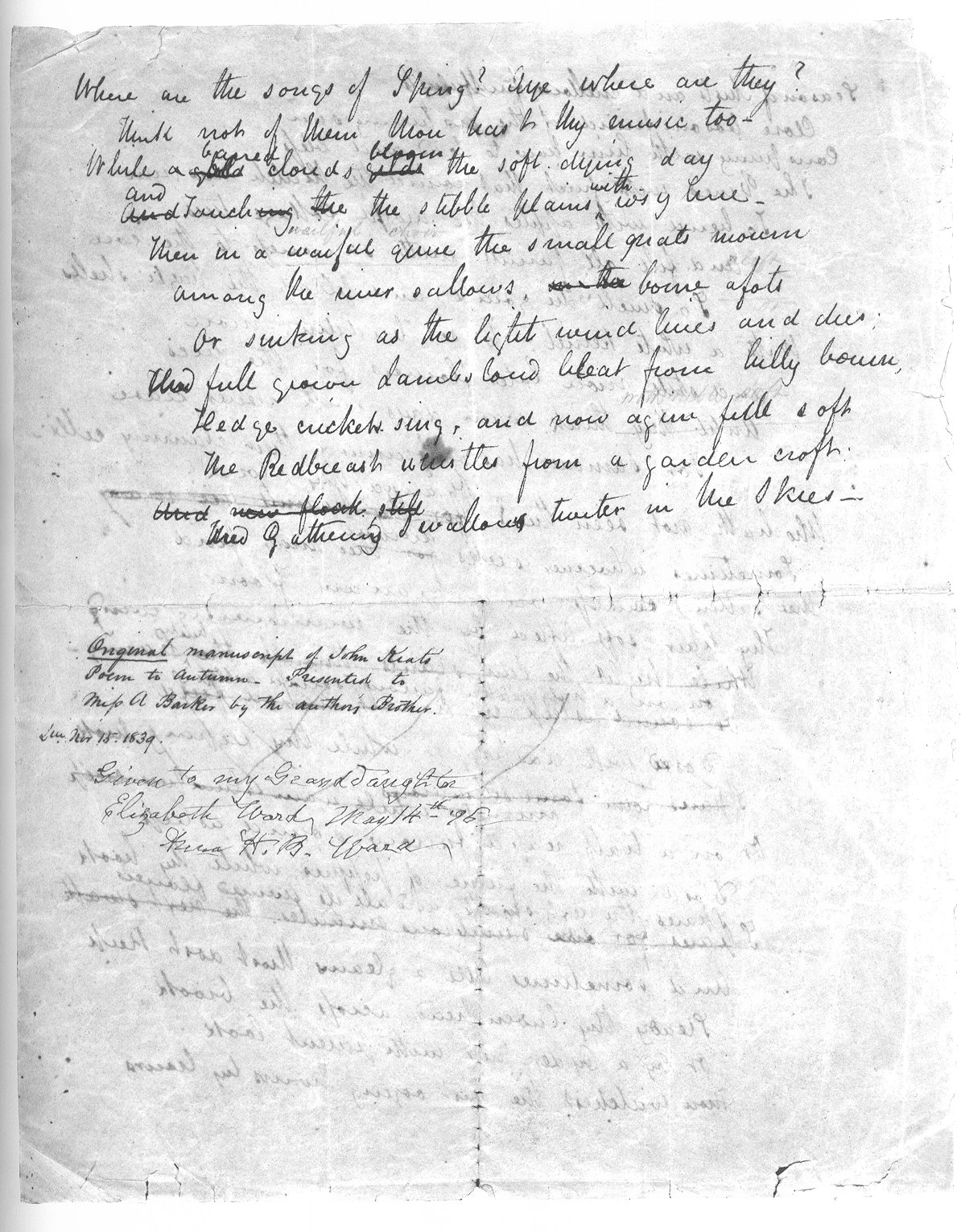
“Where are the songs of Spring? Ay, where are they? / Think not of them, thou hast thy music too,– / While barred clouds bloom the soft-dying day…” (“To Autumn,” John Keats)

- John Keats – “To Autumn” Manuscript – Pg. 1


- John Keats – “To Autumn” Manuscript – Pg. 2
From “Oatmeal” by Galway Kinnell:
Possibly it is even worse to eat oatmeal with an imaginary companion.
Nevertheless, yesterday morning, I ate my oatmeal porridge, as he called it, with John Keats.
Keats said I was absolutely right to invite him:
due to its glutinous texture, gluey lumpishness, hint of slime,??? and unusual willingness to disintegrate, oatmeal should???not be eaten alone.
He said that in his opinion, however, it is perfectly OK to eat it with an imaginary companion, and that he himself had??? enjoyed memorable porridges with Edmund Spenser and John??? Milton.
Even if eating oatmeal with an imaginary companion is not as??? wholesome as Keats claims, still, you can learn something??? from it.. . . . . . . . . . . . . . . . . . .
When breakfast was over, John recited “To Autumn.”
He recited it slowly, with much feeling, and he articulated the words lovingly, and his odd accent sounded sweet.
He didn’t offer the story of writing “To Autumn,” I doubt if there ???is much of one.
But he did say the sight of a just-harvested oat field got him started??? on it, and two of the lines, “For Summer has o’er-brimmed their ???clammy cells” and “Thou watchest the last oozings hours by hours,”??? came to him while eating oatmeal alone.
I can see him drawing a spoon through the stuff, gazing into the glimmering??? furrows, muttering.
Maybe there is no sublime; only the shining of the amnion’s tatters.
*
“So dawn goes down to day,” and each day from now until the heart of winter will be descending to darkness sooner. But it is this shift to darkness that is the primary stimulus for all the fall color:
The timing of color change and leaf fall are primarily regulated by the calendar, that is, the increasing length of night. None of the other environmental influences — temperature, rainfall, food supply, and so on — are as unvarying as the steadily increasing length of night during autumn…. (Northeastern Area Forest Service)
So try to take some solace in the dark and dying, the revealed carotenoids and anthocyanins, “all the changes there’ll be / by the time it gets dark.”