

This evening I watched the five Academy Award-nominated live-action short films for 2010 in Ann Arbor’s luminous Michigan Theater. The films come from across the globe: India, Denmark, Australia, Ireland, and Sweden. Ranging from seventeen to twenty-two minutes, they all begin mid-stride, pulling us quickly into worlds of mayhem (the Dutch, the Australians) and magic (the slapstick-happy Swedes). “There’s no time to lose!” each film team screams. (The Irish entry, The Door, cuts to the literal chase.) It’s as if each director was following Elmore Leonard‘s oft-quoted dictum: “I try to leave out the parts that people skip.”
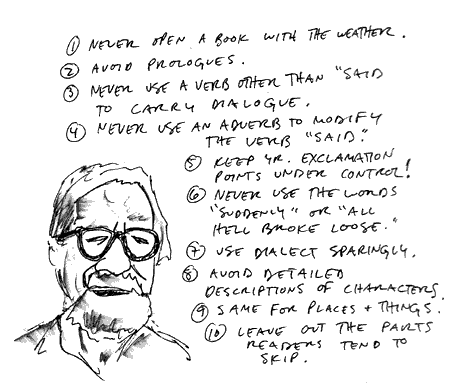
I’ve been thinking about speed (not that kind) all week, as I’ve been reading and writing short-short stories along with my fiction workshop. Our gateway text has been Sudden Fiction International, a collection of sixty quicksilver stories by the likes of Donald Barthelme, Margaret Atwood, Fernando Sorrentino, Doris Lessing, and Jamaica Kincaid. In a witty introduction, Charles Baxter extols the virtues of the form (spontaneity, humor, surprise) and then concludes: “With the noise of the contemporary world increasing exponentially hour by hour, and people trying to drown you with words alone, these stories have managed a neat trick: they put up and shut up.”


One of the delights of the short-short form is that it dares one to go even farther (or perhaps less far), to go short-short-short, or short-short-short-short. My favorite story in Micro Fiction: An Anthology of Really Short Stories comes from Amy Hempel. It’s called “Housewife,” and it’s one of the few works of fiction I’ve successfully memorized:
She would always sleep with her husband and with another man in the course of the same day, and then the rest of the day, for whatever was left to her of that day, she would exploit by incanting, “French film, French film.”
Isn’t this one of the great sentences in the language? The mid-sentence adjustment (“for whatever was left to her of that day”), the surprising rise in diction (“exploit by incanting”), the double-trochee hammer at the end — all brilliant. To tweak Baxter’s formulation, the story puts out (twice!) and triumphantly shuts the door.
About ten years ago I became briefly obsessed with Joe Wenderoth’s Letters to Wendy’s. Here was a book that seemed to be reinventing the short-short form and the prose poem in the same bold stroke. Single letters from the collection would hit two or three different tonal registers, but no letter was ever longer than eight lines. (The customer-comment card served as canvas and constraint.) Opening the book at random right now, I happen upon the “December 30, 1996” entry — and there’s that word, “register,” doing a different kind of work:
Why is it that, without the register, all Wendy’s activity is halted? Ordering, eating, preparing the food — are we to believe all of this is subservient to the cash transaction? Marx wanted to take a sledge hammer to all registers. He hoped we’d recover our senses in the long lines that ensued. I don’t think he understood how awful it is to actually climb over the counter.
At the start of a 2002 reading at New York’s KGB Bar, Wenderoth read John Berryman’s Dream Song 29. (He claimed — rightly, I’m sure — that the day marked “the anniversary of John Berryman being drunk once.”) Later this week I’ll be in the Twin Cities, where a friend has promised to take me to the spot where Berryman waved goodbye. So my next post will likely be filled with the sad-funny lightning jags of Huffy Henry. But after that, I’d like to return to this idea of speed and look at poems that blaze their way to the finish line. (Here’s Wenderoth again, from a 2001 Rain Taxi interview with Graham Foust: “Can I convey to you how happy I am to find a poem that is not too long?”) And I’d like to encourage you to see the Oscar-nominated live-action short films, if they come to your town. At the end of “The New Tenants,” after a dozen or so minutes of ridiculous violence, the two lovers (one of whom is the wonderful David Rakoff) go waltzing off.
Will it surprise you to learn that it’s a really fast waltz?
