


Sunetra Gupta is the author of five novels, most recently So Good in Black. Her novels have been awarded the Sahitya Akademi Award, the Southern Arts Literature Prize, shortlisted for the Crossword Award, and longlisted for the Orange Prize. She was born in Calcutta, and wrote her first works of fiction in Bengali; she is also an accomplished translator of Rabindranath Tagore. She lives in Oxford, where she is professor of theoretical epidemiology at Oxford University. In 2009 she was awarded the Royal Society Rosalind Franklin Award for scientific achievement.
*
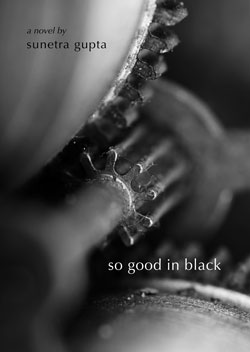
This past winter in my work as editor at Clockroot Books I had the great pleasure of copy-editing Sunetra Gupta’s So Good in Black, which has just been released in the US. In the course of our editorial conversations I got to hear Gupta discuss her approach to punctuation and to the novel’s unusual formatting, a discussion that was fascinating to share in: how these formatting choices answer to matters of craft, to Gupta’s commanding sense of rhythm and the movement of the text on the page.
In So Good in Black Gupta employs an unconventional style of indentation: lines and paragraphs narration are indented a quarter-inch, but lines of dialogue are indented a half-inch (and no quotation marks are used). When a paragraph of dialogue extends over a single line, the next line of narration is flush left, rather than indented. In this way, the indentation system functions by negative space: a line of dialogue will always be indented a quarter-inch more than the next line of narration. (Such is the gap between print and web technology that I cannot in fact show you this here; WordPress won’t preserve the formatting. Imagine, try it in Word, or find a copy of the novel; I recommend the latter.)
I invited Sunetra to this blog to discuss this choice, as well as other aspects of her craft. And to talk about the craft of So Good in Black means considering Gupta’s propulsive, extended, elegant sentences, in which the period moves to the background and the comma takes the stage. One small sample:
He explained that he was calling from Digha, from his house by the sea where he had convinced Nikhilesh to withdraw with his granddaughter, so that she might be shielded from the many attitudes of grief that were likely to surround her in Calcutta, the raw and redflecked sympathy of strangers, the many awkward murmurings that were liable to destroy whatever precarious equilibrium her childmind might have sought and achieved, for she had been very close to Damini, had just returned from spending a week with her in Darjeeling when the dreadful news had come that she was missing, and soon after the very much worse news that she had been found, dead.
Our conversation follows.
HP: What inspired you to reject “conventional” paragraph formatting for So Good in Black? What limits did you aim to overcome? In the formatting of So Good in Black the main distinction is between narration and dialogue. I wonder how you’ve approached this issue—narration vs. dialogue, what relation they have and how much to distinguish between them, the matter of how to punctuate dialogue—differently throughout your five novels, and by what criteria you’ve taken on distinct approaches?
SG: Dialogue has encroached upon my writing in a way that I would never have foreseen; when it happened, it was a challenge to accommodate within my writing style. Previously I had used dialogue so sparsely that it was amenable to being set out as a single indented line or even merged into a paragraph. The passages of frank playwriting—in which this particular novel abounds—confounded my efforts to find an appropriate format to fuse it with the narration. Two different editorial experiences ensued: in the Indian edition, each decision was queried, and each time some specific aesthetic solution was found; with the American edition however an algorithm based on different depths of indentation was proposed (by you) and very gratefully accepted.
All of this of course arises because of my stern refusal to use quotation marks. I find these an intrusion (only when writing, not when I am reading)—they seem to be wanting to reach up and pull down my writing to a level space where it does not want to be. Also, they create too much of a firm demarcation between utterance and narrative; what I was seeking was some delimiter which preserved the rhythm of narration rather than opposing it.
I have a certain resistance to what you might call banal dialogue in literature, and will often stop reading a book it contains too much of it. Banal dialogue can be used to good effect in cinema (and even rendered exquisite such as by Ozu) and certainly has its place in theatre but has a difficult relationship with literary fiction. There are some writers who can make careful and judicious use of it—Amit Chaudhuri is a good example—but all too often, it serves as a filler or, at best, a lazy way to establish how characters and events are connected. Stylized speech—which can either be sparse or heavily decorated—is always more interesting to me.
I became inclined, while writing So Good in Black, to use dialogue either to open or, more regularly, to end the various segments of which it is composed. I believe, in this regard, that it had more of a formal participation in the construction of these segments than in lending the characters each a voice. It was thus mainly governed by a set of harmonic considerations which belonged to the overall architecture of the novel, and yet it was also important to me that each character should be able to firmly establish itself within these constraints and grow in the mind of the reader. All this they (the characters) had to do without the benefit of being assigned unique verbal signatures. It seems from the various reactions I have had to the book that some characters, like Byron Mallick, were successful in this—while others, like Ela perhaps, may have become victims of the process.
HP: Elsewhere you’ve discussed your “visceral” feelings about punctuation. Which writers do you find yourself returning to as inspirations in the field of punctuation? What is your relationship to the so-called comma splice? (A label that, I think, makes a perfectly natural thing sound unfairly alien.) Can you even talk for a moment about the comma, period, semi-colon, and em-dash, and what role they play—as characters of sorts?—in your prose and in your writing process? (By which I mean, does your punctuation tend to change between first and later drafts? Between your earlier and more recent writing?)
SG: I completely agree that the comma splice (like the split infinitive) is treated like a disease rather than a device. I seem to have a very natural relationship with the splice—perhaps, in a perfect world, it would not share a symbol with the conventional comma but I have no aversion to using the comma in this way. There are certain types of punctuation that I tend to avoid while writing fiction but use liberally in scientific writing, such as a semi-colon. Of course, the semi-colon is a central structural motif in Woolf and I have a huge affinity with her writing—but it seems to have no place in my own writing. I have found myself relying more and more on dashes but I could not use them in rapid sequence like Emily Dickinson—the comma (splice) is more suitable for the type of rhythm I wish to establish. I suppose one reason we are having this conversation is because there is actually no satisfactory “notation” available to establish the connections and the pauses between pieces of prose; we have borrowed the comma, the semi-colon, the em-dash to fulfil these roles as suits our individual sensibilities. I don’t think it would work to invent a new symbol for the splice—besides I love the movement of the comma, how it gently sweeps away one thought and replaces it with another. The dash creates more of the dependence between clauses, while the semi-colon seems to interrupt. The reason I use the period so sparingly is because it is so final, like a bullet through the page or a stab wound. In Bengali, it has a gentler presence—the dari, or Bengali full-stop looks like this – | – I never felt the same aversion to using it when I wrote in Bengali but that was a long time ago.
It is, of course, quite natural that we should respond at a visceral level to punctuation and I have become quite fascinated by the various ways in which other writers—and readers—do so. The semi-colon, for instance, so integral to the architecture of Woolf’s prose evokes a deep loathing in Vonnegut who calls them “transvestite hermaprodites representing absolutely nothing.” Samuel Johnson disapproved of parentheses (according to Boswell, anyway, who makes the point that “in all his voluminous writings not a half a dozen of them will be found”) but probably for intellectual rather than visceral reasons. But when Conor Cruise O’Brien, in biography of Edmund Burke, says “the brackets are like handcuffs” he is registering a visceral response. To Brenda Hillman, Emily Dickinson’s dashes create the sensation of walking across “a rope-bridge… strung across a raging river far below,” while Susan Howe thinks of them as stitches through her poems. John Banville even speaks of tenses in physical terms: “I cling to the present tense as to a sheer cliff’s last handhold” says the narrator of Athena. The stab wound analogy is also his: “like the full-stop the doctor stabbed into his death certificate” (Eclipse).
HP: Your work moves not only geographically through India, the United Kingdom, and the US, but also linguistically. You’ve written in and translate from Bengali, and of course write both creative and scientific work in English, and, I imagine, in an English that encompasses something of the breadth of these locations and dialects. Can you talk about the different languages, including the different “Englishes,” that you have access to as a reader and writer, and how they interact or are given voice in your work?
SG: I had no acquaintance with the English language until I was four and a half years old which, of course, is still very early in life so I had no trouble picking it up. We had just moved to Zambia after living for three years in Ethiopia, where I spoke Bengali with my parents and Amharic with my nanny (the one friend I had then was also a little Bengali boy) and I had no idea that it was possible for people to converse in a language I might not understand. As a result, I was absolutely infuriated that the little English girls to came to welcome me to our new home spoke in such a way that I could make no sense of what they were saying. I learnt to read and write in English at school, but was also instructed in Bengali at home as it was always my parents’ intention to return to Calcutta. When we finally did go back in 1976 (I was then eleven), I was at first enrolled in a missionary school by the name of La Martiniere with a long and distinguished tradition of offering young ladies an excellent and exclusive private education in English, which meant that while I still had a lot of catching up to do, I was still studying Bengali as a second language. But after two years there, encouraged by my father, I made a very conscious decision to switch to an experimental school by the name of Patha Bhavan which had been founded in the ’60s by a group of intellectuals, many of whom he knew very well. I put myself through a course of rigorous immersion in Bengali, devouring the literature—and also starting to write in Bengali—I did in fact manage to publish a few science fiction short stories in little magazines, but I was always attracted to the novel as a form and there are several unfinished Bengali manuscripts gathering dust somewhere in my mother’s flat in Calcutta. These were my formative years, and so I owe as much to the writings of Bengali moderns like Premen Mitra and Jibananda Das as I do to TS Eliot and Virginia Woolf in the construction of my literary sensibilities. Bengali humour—not just humorist tradition, but the use of irony in everyday life—was an important ingredient of my life in Calcutta—whatever ludic qualities there are in my prose derive from this as much as my later exposure to writers like Nabokov, Borges, Calvino. Rather by chance, I ended up in 1984 as an undergraduate at Princeton University, but was still writing in Bengali in my summer vacations back home. In my senior year, however, I decided to attend a Creative Writing workshop with Joyce Carol Oates, and that was when I began write in English.
I think English is a wonderful language, and it is possible that it has a unique degree of malleability—it’s hard for me to say, as I do not know any other language as well other than Bengali. Would Bengali, if it had been disseminated as widely as English, mutated into different forms in the same way? I really do not know. The Bengali language itself has a very recent history of evolution connected to the 19th-century phenomenon of the Bengali Renaissance, so it is certainly capable of adapting itself to new circumstances. My general feeling about all languages is that they are all unique and unpredictable, and it is possible to find your own voice within any of them. Naturally, the language itself will condition the voice that you find within it, and the way you think in general. But I do not think that it is useful to have any particular political allegiances with language. Many of us who write in English, even though it is not our mother tongue, have been called upon repeatedly to justify this action, as if it were an obvious disloyalty. I have never been much exercised by this—as far as I am concerned, the only option available to me when it comes to languages is serial monogamy, and I know within myself that the only reason I “abandoned” Bengali was because it was difficult for me to remain immersed in it while living away from Calcutta. Recently, though, I’ve revised my position somewhat upon reading Arvind Krishna Mehrotra’s thoughts on this subject. To quote from one of his poems, rather than essays: “Insomnia brings lucidity, And a borrowed voice sets the true one, Free.” We are permanently in search of our true voice, and this has to be mediated through a borrowed voice—to imagine that our mother tongue is less of a borrowed voice than any other is perhaps a mistake.
HP: “Accessibility” and “readability ” are two ideas that seem to be privileged in this particular moment in US literature, offered in contrast to a vague idea of “difficulty,” of “difficult” literature. I wonder if you could talk for a moment about ideas of difficulty and accessibility in literature, how you see these being discussed, and what these mean to you. And perhaps this is a place for me to ask about your work as a scientist, and how ideas of difficulty or accessibility in science writing may in some way usefully contrast or shed light on literary debates.
SG: Well, like Oscar Wilde, I firmly believe that “Art should never try to be popular.” In the second part of that sentence he says that, instead, “the public should try and make itself artistic”; I would go further to say that the “public” are, in fact, inherently artistic and that it is an insult to them for art to try and make itself “accessible” on their account.
Indeed, it surprises me that the public tolerate such words as “accessibility” as their immediate implication is that they themselves are either stupid or lazy or both. The central fallacy here, as Howard Barker puts it, is that “All things that are not accessible must be privileged… all spaces that are hidden are ipso facto the preserves of an elite, and all ideas or works of art that fail to communicate themselves are – obscure.”
Some great works of fiction are highly “accessible” to inexperienced readers and naturally therefore are to be lauded for serving the purpose of drawing them in to enriching world of fiction. I am forever searching out accessible books for my teenage daughters, but that’s because they are children and require education. The endorsement of “accessibility” in current times is, to my mind, a sad by-product of the uneasy relationship between the writing of books and the selling of them; the market ultimately has no place in the temple, unless a temple is to be made of the market itself.
Of course, an unhealthy regard for “high culture”carries its own problems. Recently re-reading Stefan Zweig’s The World of Yesterday I was struck by the similarities in this respect between Viennese society in the late 19th century and the Calcutta I grew up in—he says for instance “The first glance of the average Viennese into his morning paper was not at events in parliament, or world affairs, but at the repertoire of the theatre”… and… “The Minister-President or the richest magnate could walk the streets of Vienna without anyone’s turning around, but a court actor or opera singer was recognised by every sales-girl and every cabdriver”… and recalls how their “old, semi-literate” cook ran in weeping because a prominent actress had died. What’s interesting is that he finds her “wild mourning” not beautiful but grotesque—and also deplores the hysteria of the crowd when Burgtheater was torn down—speaks of people taking splinters home and treasuring them like relics. Like Zweig, I became fascinated by the torque between this “fanaticism for art” and the enrichment it offers “even in the lower circles, the poorest drew a certain instinct for beauty… holiest exuberance of life”—as kind of trickle down effect of culture—and in my first novel, Memories of Rain, I tried to explore this in the context of the effect of Tagore on the culture of Calcutta.
To take up your final point on science—most of how science is done is fairly inaccessible, even to other scientists, and yet what it actually means can be communicated to the public, and we are very fortunate at the moment to have a wealth of talent in this area. Accessible and responsible science writing is crucial as the public have to trust these intermediaries. Naturally, the inherent lack of accessibility makes science prone to abuse—I have spoken before about the profligate use of mathematical models to make predictions about the future where, in many instances, the apparent rigour of mathematics can appear to lend an illusion of certainty where none exists.