

At this risk of sounding like I’m quoting a line cut from The Sound of Music: how do you hold a semester’s worth of poetic reading in mind at the end of that experience?
I put this question to the students in my “Poetry & Social Justice” course as our semester together came to a close; their task was particularly challenging, as the semester’s pedagogy was rooted in pushing against an assumed canon, against hierarchies, against categorizations, oversimplifications, and exclusions. In a more “traditional” course, the textbook I chose and the units I planned out on the syllabus would act to map and visualize intended learning. But in this course, each week’s reading selection was intentionally very modular, organized around a concern that transcended a particular aesthetic moment, movement, or innovation. The course included a number of events, guests, and community collaborators, which meant that “my” already various reading selections became part of an even broader conversation of readings. The students themselves also introduced readings of their own.
It was exciting when students, guests, and collaborators introduced readings entirely new to me; it was also exciting when our attention and intentions overlapped, as when Tony Medina introduced a “Where I’m from” exercise the week before I intended to do the same. Being able to build off of his perspective and energy the next week, rather than presenting myself as the authority on such an endeavor, was an opportunity that simply couldn’t have arisen within a more traditional framework. The same went for Loma’s writing exercise based off of Eduardo C. Corral’s “In Colorado My Father Scoured and Stacked Dishes”; the fact that I had assigned the poem as a reading without an accompanying writing exercise, not knowing that Loma was going to present the poem as the catalyst for a writing prompt, reinforced the sense of discovery inherent in any given poem.
But the end of a semester calls for reflection; how do you synthesize months’ worth of disparate readings in retrospect? We had been using our words all semester; I decided that we would visualize instead. The students split into four groups: thematic, formal, temporal, and spatial. Their task was to draw (literally) connections between the semester’s various readings. Listening in on each group’s conversations, the wealth of remembered poetry coupled with the lack of (or rather, refusal of) easy categorical certainty was heartening to hear.
In the temporal group, which decided to create a timeline, I heard questions about origins – how far back did such a timeline need to travel into the past to do justice to traditions and lineages? In the spatial group, I heard discussion of how the poets themselves might want their sense of “place” located on a map if their country of origin no longer existed as it did when they lived there, or if they became a refugee, immigrated, had undocumented citizenship, lived in exile. They brought in string and thumbtacks and created a map like a cat’s-cradle—poets still connected to their origins:

I heard the formal group decide to do away with its original title altogether, eschewing the word “formal” for the term “poetic devices,” broadening the possible connections between poems to include, as one example, tonal commonalities:
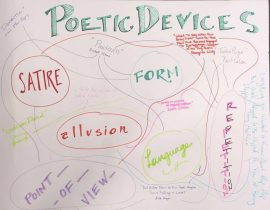
And the thematic group made color-coded lists, then immediately complicated their own lists by starring the poems in one list that shared themes with another list in the other list’s color—rainbow constellations.
It seems counterintuitive to praise students for their frustration and uncertainty—but that’s what I did. I tried to make it clear that the conversations that arose around these visualizations weren’t getting in the way of some “right answer” or intention—they were the intention. We could make connections without glossing over the realities of lived lives or leaving messy truths out of the picture.
And it was messy – literally. If an administrator had walked in, they would have seen students sprawled on the floor, surrounded by markers, colored pencils, tape, and cardboard. So many times this past semester, I have thought of how bell hooks mentions “excitement in higher education” in Teaching to Transgress: Education as the Practice of Freedom, noting that it is “viewed as potentially disruptive of the atmosphere of seriousness assumed to be essential to the learning process.” She continues: “To enter classroom settings in colleges and universities with the will to share the desire to encourage excitement, was to transgress . . . Agendas had to be flexible, had to allow for spontaneous shifts in direction.” I felt like I learned more about what my students “knew” through watching and listening to them draw and debate, color and collaborate with each other than I often take away from final essays. Why? Was it the collaborative, the visual, or the element of surprise? I’m not sure, but I know I want to try all three again in a future class, drawing my own line from this class to the next.