


On Yom Kippur, we ask that we are written into The Book of Life for one more year. And in thinking of The Book, I keep returning to this past May, when I visited Nomi Stone’s class “The Anthropology of Awe and Terror” at Princeton University. Together, we put together a Haggadah, and led a Seder for her class that while, rooted heavily in Jewish tradition, was inclusive and nondenominational. We were joined by graduate student Jessica O’Rourke-Suchoff, as well as poet and Princeton Hodder Fellow Jenny Johnson. (Read some of Jenny’s incredible work here.) Nomi tied into the Haggadah several longer texts such as Solmaz Sharif’s LOOK and Theodor Adorno’s “Cultural Criticism and Society,” while I added quite a few poems that seemed fitting for a specific part of the Seder.
One of the most beautiful things about Nomi Stone is her openness; only a few of the poets I suggested were Jewish, and she readily welcomed these voices into our Haggadah. During the Seder, we went around the room so that everyone had a chance to read, participate and discuss the texts, and how they related to the tradition we had tied them to. For the Shehechianu (a blessing that marks the first time on a Jewish occasion a group does something together) we read Lorna Dee Cervantes’s “First Thought“. For the Urchatz, or the Washing of the Hands, we read Emmy Perez’s “The River on Our Faces.” In explaining why there are olives on the Seder plate, we read a section from Nazim Hikmet’s “On Living“. For the blessing over the matzah, we read Erika Meitner’s “Ghost Eden.” And our texts were not all poems either: we watched Beyoncé’s music video “Freedom” for the Second Cup V’hesalti (I Will Free You) for the section on Makat B’Chorot (Slaying of the First Born).

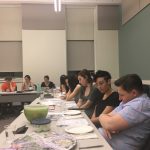
I think back to the Ma Nishtana, and the question that appears at the beginning of The Four Questions: “Why is tonight different from all other nights?” While Seders in my father’s household were a very inclusive affair, often with an aunt and cousin or two from my mother’s Mexican Catholic side joining us, my father patiently explaining why we ate bitter herbs or why we hid the Afikomen, being part of the Seder that night with Nomi’s class, with students whom came from all different kinds of backgrounds, and meeting Jessica and Jenny for the first time, awakened something within me at that time: the desire to return to tradition, but also the desire to actively evolve those traditions.
The evening certainly began strange enough. A tumbler I’d filled with Icelandic vodka (to spike the grape juice for Nomi, Jenny and myself) was lifted from my bag on the train, but whoever took it left my wallet and my phone. What a strange choice to make: who could possibly have known its contents but myself? When Nomi and I concluded the Seder, we took it as an omen that called for a particular clear-headedness and clarity. We were both tired and drained from the work week, but agreed the Seder had opened up something in everyone.

Nomi was yawning into the steering wheel of her car, and pushing herself up with her arms as she made a turn. The road at that moment on which she turned was dark and deserted, the only light from a lamppost we’d already past.
There was a brief moment I couldn’t see her, only her silhouette from the light cast by road and headlights.
And it was then I really considered what we’d done with the Haggadah.
That that took two different kinds of trust.
The trust between two different people in rewriting a sacred text in order to create something transcendent, while still rooted in the original.
And the trust between yourself and your faith, that you can remain a Jew while embracing the idea that the Book is not yet finished.
And that most likely It never will be.
*
Later that night, when I got home, I read in a science blog I follow that the universe can’t help but be self-destructive, for it is always going toward, only so that it can use the least amount of energy. That while the universe is expanding (and we still don’t know why), it is also shrinking, taking what is beyond earth ever further from us.
And I thought about all the ways in which Nomi and I would have never met. And even if we did, the Seder may not have happened, for I was originally supposed to visit her class another day that semester. So believe me when I say in that brief moment I couldn’t see her that night in the car, it was then I felt both the absence and the possibility of so many other timelines, the many other texts we would and would not rewrite together, with others. Those we write in solitude. Those we pray in solitude, as we ask for another year. The texts we are living. The texts we escape. The texts which reveal the nights which are truly different from all others. The nights which reveal when we lost our foundations, our absolute certainty, our bright-toned greetings. The year for which we are asking.
All the years for which we ask of The Book, which expands both the mortal and infinite distances within us. The years in which we say: Don’t forget my name. The years which speak our name once more.
That moment in each year in which I begin to feel my faith going toward a little fainter, and I’m wandering alone on a deserted street that someone appears and reaches for my hand in the darkness.
Rarely these days does my faith— my unsteady, imperfect, weary faith— let me pull away.
Rarely these days do I not trust this strange, strange grace, still unknown, still unnamed.