

My maternal grandfather was a coal miner. The job killed him, or at least I once believed it did based on the shaky family lore I heard as a child. This was how I came to understand it: Years after working in the mines, he suffered from lung cancer, which the doctors treated with cobalt therapy, which later led to the leukemia that led to his death.
I now suspect this information is all wrong. My cursory online research doesn’t indicate a connection between cobalt therapy and an increased risk of leukemia. A family member confirms my grandfather died of leukemia but says cobalt treatments had nothing to do with it, that the disease was just bad luck. I do, however, come across some research suggesting a potential link between underground coal mining and leukemia.
But maybe those details don’t matter. What matters is my grandfather was a miner, and he supported his family, and his two children left that tiny Pennsylvania coal-mining town to lead bigger lives, and then he died before his daughter’s first child was born.
My mother loved her father beyond measure. Once, she showed me the photographs he took of their town from the nearby mountain he liked to hike. He’d take her with him on the weekends when she was young, so she was often with him when he snapped the photos that spanned the seasons year after year: summer trees, autumn foliage, bare winter landscape, spring coming back to life. This cycle repeats itself throughout the photo album.
“He was such a good father,” she told me. “I wish you could have known him.”
Then she put the photos away, and that was that.
*
During my six years working as an editor of an occupational safety magazine, I wrote often about the risks of coal mining. Black lung, confined spaces, the threat of fire and gas and collapse. I learned enough to know that a job like coal mining could lead to disease that manifests far in the future, long after the miner has retired.
The disasters are far easier to track. Explosions, landslides, and poisonous gas releases create instant death tolls and thus garner media attention. I lost count of how many fatal coal-mining fatalities I covered while working for that publication. One of the most devastating cases was the Upper Big Branch Mine disaster in West Virginia, in which twenty-nine miners perished underground following a coal dust explosion.
My colleague at the time also had a family connection to coal mining. She once referenced a press event in which reporters were invited down into a mine shaft “to see how it all works,” a prospect she found horrifying.
“You could not pay me enough money to go down into a coal mine,” she told me. “Never. Not even for one second.”
*
When I drive along the PA Turnpike, I pass a billboard advertising the state’s coal industry as “clean and green.” Another billboard reads:
AFFORDABLE COAL ENERGY
Increasingly Green
and always
RED, WHITE & BLUE
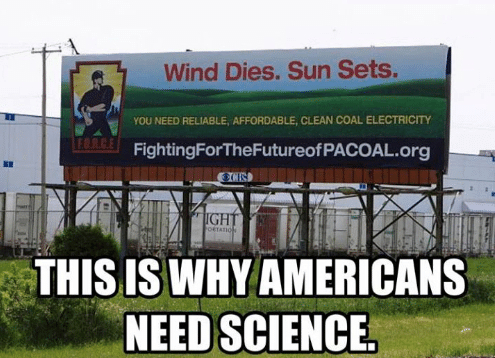
The image of yet another pro-coal billboard can be found online, circulated by those who mock its specious warning against alternative energy. This billboard reads: “Wind Dies. Sun Sets. You need reliable, affordable, clean coal electricity.”
Elsewhere on the Turnpike, meanwhile, the turbines of the Somerset Wind Farm loom into view.
I visited a wind farm once, in Wales, during the semester I studied abroad in London as an undergraduate. It was a lonely place, the turbines god-like, the surrounding landscape washed in gray and battered by wind. It was the kind of thing I imagine my grandfather would have found foreign: his granddaughter as a young woman privileged enough to study across the Atlantic, to spend a weekend driving around Wales just for fun.
But it was also an experience made possible, if indirectly, through my grandfather’s hard work. Not to mention the sense of security and ambition he instilled in my mother who, in turn, instilled it in me.
*
“Writing is hard for every last one of us,” Cheryl Strayed wrote in one of her Dear Sugar columns. She adds:
Coal mining is harder. Do you think miners stand around all day talking about how hard it is to mine for coal? They do not. They simply dig.
That line—“Coal mining is harder”—sometimes pops into my mind as I work on novel revisions. I have revised and rewritten and re-imagined this novel so many times over the last few years that sometimes I worry I’ll be used up, my ideas evaporated, the well run plumb dry. And yet just today I hit a new vein. Just today, I was able to go deeper, marveling at how there’s still so much more waiting beneath the surface.
I write new words. I conjure new realities. There at my writing desk, I try to picture my maternal grandfather observing me work. What would he make of this typing, this screen, this imagined world taking shape under my fingertips?
How unlike coal this work is. I often complain about my messy writing habits—how I don’t plot my fiction in advance, how I always feel I’m writing in the dark—but the truth is, the writing process is clean and safe. In one sense, it’s an internal effort, the kind of work that requires the writer to go deep. But in a physical sense, it’s a lot simpler than that.
It all takes place above the surface.
*
A few years ago, I went through a stage where I tried photographing Lake Erie and the Cleveland skyline from the same spot in my neighborhood on an ongoing basis. I stood at the edge of a lakeside cliff and captured a range of seasons: glimmering fall, iced-over winter, melted spring, blue-sky summer.
I didn’t realize, at first, that my project mimicked what my grandfather had done decades ago on that mountain in his hometown. I didn’t connect my photographs to how he left behind his work in the mines to hike with his daughter, to raise his camera against natural beauty.
In those moments he was not underground, not breathing in the dust that could harm him, but rather standing above the surface. And not only that, but he climbed a modest mountain. He reached a place where he could look down upon the town and trees spreading beneath him and say to my mother, then just a child: This is where we belong. This could all be yours.