

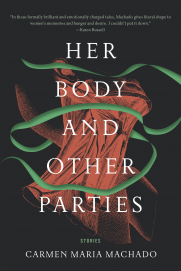
Although not all the stories in Carmen Maria Machado’s Her Body and Other Parties reach the accumulative electricity of its first tale, “The Husband Stitch,” this is not uncommon in a short fiction collection; it also has a lot to do with the fact that this particular story is just so darn good. It would be difficult to maintain throughout the peak Machado reaches at points in this book.
“The Husband Stitch” reanimates that girl with the ribbon around her neck that we used to whisper about at sleepovers. This girl is the perfect symbol for this particular story and for the collection as a whole. This ribbon, if undone, just might unleash the supposedly mad world that’s always in danger of roaring out of all women should we be effectively opened.
As you might have already guessed, Machado brings the madwoman in the attic trope to the party. In “The Resident,” which takes place at a writing retreat, another female artist demands of our writer protagonist, “Do you ever worry…that you’re the madwoman in the attic?…Do you ever worry about writing the madwoman-in-the-attic story?…You know. That old trope. Writing a story where the female protagonist is utterly batty. It’s sort of tiresome and regressive and, well, done.” Well, watch out, everyone, because that madwoman is coming roaring towards you at a velocity no ribbon or husband stitch can do a goddam thing about. As the narrator of “The Mothers,” puts it, “something inside of me is breaking; I am a continent but I will not hold.”
The textual madwoman in the attic is “mad” as in purportedly mentally ill, but also as in mad as hell and not gonna take it anymore. This woman, with her rage and supposed lunacy all hidden away up there in the attic, is the ultimate female monster, isn’t she? Like most ogres, we must see her from afar for her to remain so. This is the recursion of the monstrous: we don’t want to look at the monster because we’re afraid, and it’s this very act of not looking that seals the monstrous deal, leaving that woman eternally in the attic and eternally mad.
But Machado doesn’t merely show us the madwoman in the attic; she unties that ribbon around her neck and takes us inside the madwoman’s attic, into her mind and body, her interiority. We see what it feels like to be her. Even more striking, we often see that she is we. But by the time we feel this, that woman doesn’t seem so very mad or so very monstrous after all.
As the narrator of “The Mothers” tells us, “You never live with a woman, you live inside of her, I overheard my father say to my brother once.” What her father refers to here is where at least some of the horror surrounding women and their interiority comes from—that uncanny sense of, “I came from her; I used to live inside her,” that I have when I look at my own mother sometimes. (I’ll spare you the other part of the father’s equation here, the mandatory overdone castration anxiety stuff, the fear of the man’s penis being lost to the dark continent of the woman’s vagina sort of thing.)
If you think about it, though, there has to be some sort of rejection of the maternal interiority or we would never be born. Machado knows her theory and the intellectual traditions in which she trudges only too well, and she has fun with it. At one point in “The Resident,” the writer character breaks out in sores and takes care of it by inserting “the pin into the original abjection.”
But this is what all horror literature does—renders literal our internal ghoulies. Of abjection, Julia Kristeva writes, “There looms, within abjection, one of those violent, dark revolts of being, directed against a threat that seems to emanate from an exorbitant outside or inside, ejected beyond the scope of the possible, the tolerable, the thinkable.” And all this leads me to Machado’s particular innovation, her addition to the madwoman in the attic stuff, what I like to call her Abject-Mother-Baby-in-the-Basement literature.
In her story “Eight Bites,” after getting bariatric surgery, our character finds a sobbing “body with nothing it needs: no stomach or bones or mouth. Just soft indents” in her basement. Curled, crying on the floor as the narrator starts kicking her (this creature comes from the weight she lost, so it’s like kicking herself in a sense), it seems like a baby. But, later, after the character dies, she tells us that this woman creature comes to collect her in a maternal mode, to love her even though she wasn’t loved back, and the narrator “will curl into her body, which was my body once.”
Machado talks a lot about the mind, but she also clearly allows for a woman’s body with its unthinking wants and needs and complaints and passions and ways backwards and forwards. All this talk of the body leads me to another thing that’s refreshing about her stories: yes, sex—ugly, beautiful, un-airbrushed intercourse; any collection that purports to hear the secret thoughts of porn stars is in a class all its own where coitus is concerned. “I pull him through the trees, and when we find a patch of clear ground I shimmy off my pantyhose, and on my hands and knees offer myself up to him. I have heard all of the stories about girls like me, and I am unafraid to make more of them.”
Machado certainly brings the body to the party, along with that tension and play between what lies outside the body and what lies within it. In “The Husband Stitch,” after her husband does what we know he’ll do all along and pulls the ribbon, the narrator notes, “If you are reading this story out loud, you may be wondering if that place my ribbon protected was wet with blood and openings, or smooth and neutered like the nexus between the legs of a doll.”
Machado reviews and interviews constantly carp on how she doesn’t deal in in the “real,” as when an interview in The Atlantic refers to her “refusal to adhere to the conventions of realism.” To me this sounds like some sort of archaic madwoman in the attic lingo. Real according to whom? As for me, I adhere to Ambrose Bierce’s definition of realism in his 1911 Devil’s Dictionary: “Realism, n. The art of depicting nature as it is seen by toads.” In response to this discourse on the refusal of the real in her work, Machado responds, “In my work, I think non-realism can be a way to insist on something different. It’s a way to tap into aspects of being a woman that can be surreal or somehow liminal—certain experiences that can feel, even, like horror.”
In “The Resident,” our writer “was reminded, for the umpteenth time, of Viktor Shklovsky’s idea of defamiliarization; of zooming in so close to something, and observing it so slowly, that it begins to warp, and change, and acquire new meaning.” This is also a great strategy for reading Her Body and Other Parties. The real strangeness in life is not the ghosts and monsters Machado conjures, but the appearance of our own body parts if we look at them up close for long enough, these outsides that accompany our insides, the part taken for the whole, the gazed upon everyday item that takes on the gravest characteristics of strangeness under sustained inquiry. Remarkably, this defamiliarization is also a tool. If we look at the supposedly normal, “real” structures of our lives as we looked at our now alien body parts, we might start to find them strange, to question them, to say, “wait a minute, why do we treat women’s bodies quite like this?”
Forget Mars; the inside of a person is the most gorgeous and frightening place in this whole universe in its anger, poignance, and possibility. The real terrain of this collection is the revelation that we humans are the real haunted houses, as we see in this book’s initial stunning epigraph from Jacqui Germain: “My body is a haunted / house that I am lost in.”
In addition to our pathological relationship to weight loss narratives, the “Eight Bites” story in which she finds that abject-mother-baby-in-the-basement foregrounds a woman who is at once mother and daughter to herself. This is the scariest female monster of all in theory because it seems to say, not only can we make the babies, but now we can make ‘em without men. This story also highlights a haunting conclusion that Machado leaves us with: that we are all simultaneously both mother and daughter, creator and created, container and contained, attic and mad woman.