

There is a particular excitement in experiencing a favorite poet’s new project unfurl, if not in real time as its poems are written, then soon after, before a collection binds them together and they enter the world surely and conclusively as one book. I’m sure I’m not the only one feeling this excitement as Terrance Hayes’s new “American Sonnet for My Past and Future Assassin” series appears in one literary magazine after another in quick succession this year – one as the April 25th Poem-a-Day selection for the Academy of American Poets poets.org site, twelve in the July/August issue of The American Poetry Review, five at Literary Hub on July 19, one in the July 31st issue of The New Yorker, four in the September issue of Poetry, one in the Fall 2017 issue of Tin House (reprinted at poets.org).
I love that the student journalists of the University of Michigan were some of the first of us to have the opportunity to reflect on Hayes’s new series after he featured the new work in his February 14 reading at the U of M, occasioning two pieces in The Michigan Daily that contextualize the project. Kaela Thut reported on the reading as follows:
The day after President Trump won the election, critically acclaimed poet and educator Terrance Hayes immediately began writing. The result? A collection of more than 30 sonnets titled “American Sonnets for my Past and Future Assassins [sic]” . . .
Hayes said explicitly that most of the sonnets were written in response to his thoughts regarding a Trump presidency, and he said one sonnet was printed on orange paper – to emulate the color of the president’s skin.
“Are you not the color of this country’s current threat advisory, and the pom-poms of a school whose mascot is a clementine?” Hayes read. “Light as a featherweight monarch, viceroy, goldfish.”
While Trump’s election may have been the catalyst for the series, Hayes’s inspiration for the “American Sonnet” form, a subversion and reclamation of the traditional form, precedes that political moment. Readers of Hayes will remember his “American Sonnet for Wanda C.” from his previous collection, How to Be Drawn (Penguin, 2015); the “American Sonnet” impulse itself is an homage to Wanda Coleman’s “American Sonnets.” He explicitly notes that “American Sonnet for Wanda C.” references lines from her “Sonnet 88” from Mercurochrome (Black Sparrow Press, 2001). Coleman’s first American Sonnets were collected in 1995, co-published by Light and Dust Books and Woodland Pattern Book Center, with others then appearing in Bathwater Wine (Black Sparrow, 1998) and Mercurochrome.
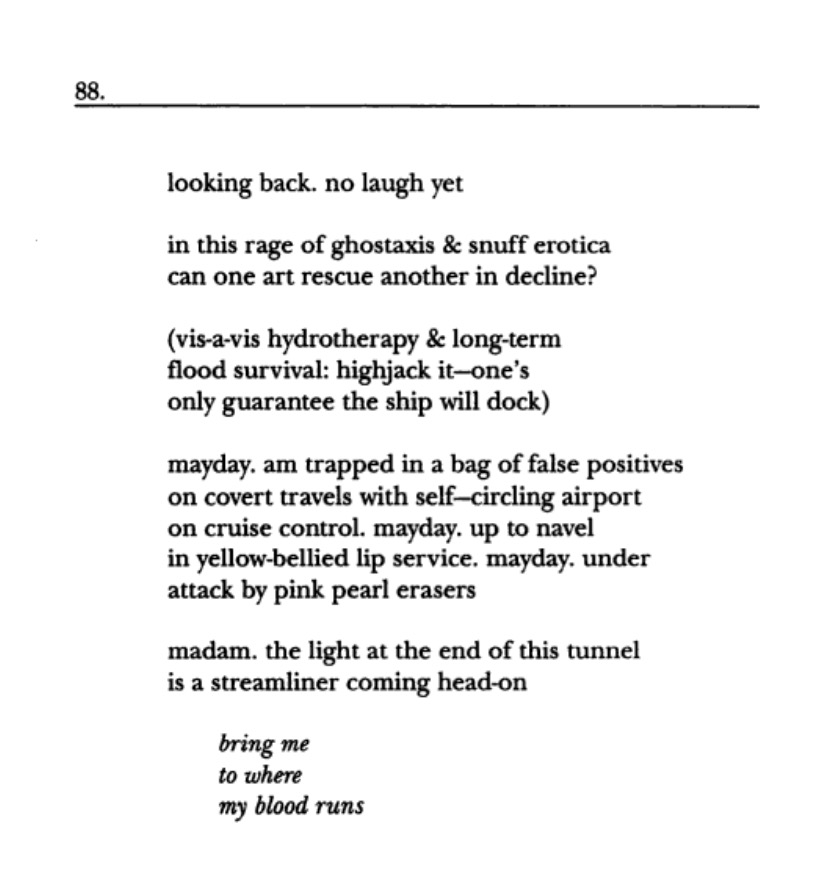
In describing Hayes’s U of M reading, Maria Robins-Somerville confirms this connection in The Michigan Daily:
He read “American Sonnet for Wanda C.” – a sonnet dedicated to Wanda Coleman, a poet who acknowledged the sonnet as an inherently exclusionary poetic form and worked to reclaim it. Expressing her experience as a Black woman, she titles her sonnets “American Sonnets” as a way of probing previously accepted notions of American identity.
As a reading that took place on Valentine’s Day, it seemed only fitting for Hayes to read sonnets, best known as 14-line poems addressed to a lover, yet his sonnets are by no means swoony or adoring, as they dwell in imagined depths and deep-rooted fear . . .
The addressees of the sonnets range from a stinkbug to President Donald Trump to the color white . . . In writing these sonnets he asked himself” “Can I write a political poem phrased as a love poem?”
I’ve written multiple posts featuring Hayes’s poetic innovation here at The Kenyon Review blog, and I’m excited to similarly explore this new series (or what we’ve seen of it so far) here in upcoming posts.
[Continued in “Hayes’s American Sonnets (Part II)”]