

It sounds like a middling 70’s folk rock act, right? Maybe in some alternate universe it is a middling 70’s folk rock act, but in my own universe it’s been the only place my head’s been at recently, last few weeks, while reading Ryan Eckes’s collection General Motors, Mikko Harvey’s collection Unstable Neighbourhood Rabbit and Eileen Myles’s Evolution. Eckes, Harvey, Myles, thricely, one after the other, left to right and back again.
A virtuosic amalgamation of lyric and civic, much of it based in the author’s hometown of Philadelphia, Ryan Eckes’s General Motors establishes him as a city poet for the 21st century city that is the Internet and its many maelstroms. Eckes is Philly to the core, to be sure–“Spurs,” the volume’s second section, is a psuedo-lyric essay/ narrative piece discussing the urban planning and non-urban planning encased in present-day Philadelphia, and General Motors takes its title from the automotive behemoth that, “along with Standard Oil, Firestone Tires, Mack, and Philips Petroleum, conspired to dismantle streetcar systems across the USA in the 1930s and 40s,” thus allowing for the exhaust, smog, congestion and traffic, traffic, traffic that every city dweller is now forced to endure–but implicit in his cityness is a shout against the “non-action” that the World Wide Web incites in all of us at least some of the time. We scroll, we stare, we sit, we scroll. We stare. We stand up, start moving. Glancing down, we stare, scroll. In “bad form” Eckes writes “99.9 percent of people eat their own god/ but there’s no word for it/ because you keep checking your phone” and “elevator no love” begins with the lines “dear internet/ world of non-action/ goodbye/ we’re free.” An adjunct professor and labor organizer, it’s a testament to Eckes’s physicality as an actual living, breathing, non-computer-generated human being that his poems in General Motors repeatedly emphasize for the reader that what we see is not who or why we are and that change is, even if distant, always possible. In “Same Time” the poet asserts: “It’s not what I’m missing that hurts, but this endless need to become something else against mass expression of collective powerlessness.” Eckes’s General Motors, however, provides some type of salve against that powerlessness, gesturing towards the refusal of apathy and all manners of the status quo.

A roundly different volume of poems, Canadian poet Mikko Harvey’s Unstable Neighbourhood Rabbit creates a world by escaping from it. In each of the poems in the volume Harvey presents a narrative dilemma—sometimes surreally rendered, sometimes abstractly, sometimes dead-set stark—that by the work’s end rewrites the definition of what a conclusion is, or disregards closure entirely. By visioning both the mundane that is fantastic and the fantastic that is mundane, Harvey allows both himself and his reader a reality that, even if illusory, is a mirage that has staying power, lingering long after the last image or sentence. Emblematic of the work contained in the book, in its entirety “Keys” reads:
The boy came to a clearing on the far side
of the forest. An abandoned piano sat in the dead grass.
It was out of tune, but that was fine—he hardly knew
the difference. At first, he played some notes just to hear them,
nothing in particular. But soon he found himself
playing the curve of his father’s belt. He played the way
his sister had looked down when she told him what
happened to her. He played what was left of his small
bag of almonds. All around him, bald trees slept.
His fingertips went numb. He played until he was no longer
playing, but was himself a key being pressed by the weight
of the pale winter day he had chosen to wander into,
having reached the end of what he could explain.
Reaching the end of what one can explain, though, is oftentimes just the beginning of a good story or poem, and in his work Harvey takes that premise and runs with it—off the track, into the mountains, entering the lost blue of the sky. Unstable Neighbourhood Rabbit is an exceptionally pleasurable reading experience, which isn’t to say it’s an easy or didactic one. Instead Harvey’s poetry defies every ordinary scope of the imagination. Full of unreported hunting accidents, beauty recovery rooms and Gordon’s goats (all of which are titles of poems in the book), Harvey’s neighbourhood isn’t scary so much as scintillating. Just in case, though, be careful. Use the buddy system. Watch your back even when your eyes are horizon-roving right in front.

While reading Eileen Myles’s Evolution I thought about greatness. Not because of the poems in the collection (although many of them are resolutely great) and more because the nature of the contemporary Great Poet seems to be one that has loose rules, ones that Myles—most definitely a Great Poet—breaks in multiple fruitful ways. It seems that after a certain age Great Poets tend to publish sparingly, and when they do publish it is only with the most prestigious magazines/journals/presses. Great Poets don’t publicize and self-promote their work in the same manner as younger poets and Great Poets attempt to keep everything—gossip, gratitude, even (especially) their Greatness—at a slight distance. Although 32% of the work continues, 68% of the work has been done. That 68%, then, weighs a wide ton.
Myles, though, disregards all those Great Poet fallacies. They publish a (good) book nearly every other year (thier last, Afterglow (a dog memoir), came out in early 2017); they write amazing poems and publish them in unknown or up-and-coming literary magazines and journals, ones that definitely aren’t The New Yorker or Poetry. (Although they publish in there sometimes too.) They speak their mind, are active on social media, read authors that aren’t their contemporaries. They stay up and keep moving and their work exists accordingly.
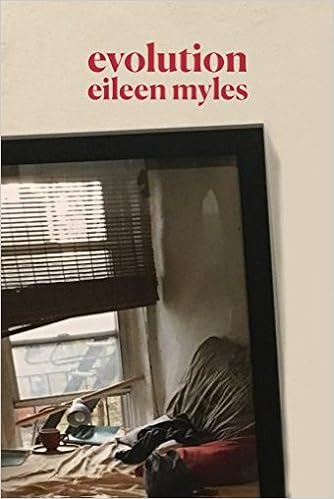
When I interviewed Myles on my writing/music radio show/podcast The Steer (plug) last month I asked them about their relationship with nostalgia and both word and concept was largely foreign to them; what’s best isn’t what happened but what will happen, no matter one’s age. The poems in Evolution, then, strive within that confine, and the title of the volume alone speaks to an ongoingness that is defiant, great but not that kind of Great. Several poems in the collection are titled “You” and my favorite one of them reads:
I’m bravely
eating my croissant
at everyone
I’m living
on my wet
board
I’m living
on my money
limits set
& the lights
lower. I worship
the blue
marks
on the hydrant
how like
the name
of a flower
Other works in the book are even better; that one just rings exceptionally true to me this grey dark December morning. As a writer and thinker Myles’s evolution continues and I personally hope it never stops.
Eckes, Harvey and Myles. They’re what I’ve been reading and thinking about lately. I can almost hear them when I sleep. They’re the best folk-rock act I’ve never known and need all the more due to that fact.