

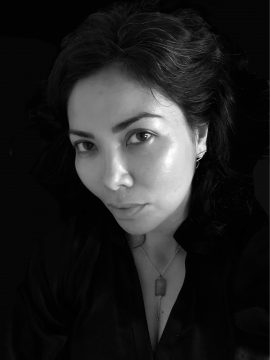
Wendy Chin-Tanner has published two poetry books with Sibling Rivalry Press, Turn (2014), which was a finalist for the Oregon Book Awards, and Anyone Will Tell You (April 2019). She also co-wrote the graphic novel American Terrorist (A Wave Blue World 2011). She’s the Founding Editor at Kin Poetry Journey, Poetry Editor at The Nervous Breakdown, and Co-Founder at A Wave Blue World. She’s also a mother of two daughters and “a proud daughter of immigrants.”
These last two biographical details find their way into her work in both graceful and striking ways. Her poetry often explores the close-up shot of identity in formation. But she also studies the ways in which it never fully forms into any recognizable shape. Still, she studies these shapes like a poet-scientist, leaving us with astonishing dispatches from these regions unknown.
Caroline Hagood: There’s a visual quality to your writing. You’ve co-written a graphic novel. Do you feel that you import any of this imagistic/graphic sensibility into your poetry?
Wendy Chin-Tanner: Definitely. My husband is a graphic novelist and publisher, and we co-founded his publishing company A Wave Blue World in 2005 where my function is primarily editing, but we have collaborated on writing and I’ve been exposed for over a decade now to the craft of sequential art. What’s especially interesting to me about that form is the relationship between different parts of the page because visual storytelling requires that the artist guide the eye from panel to panel. And then the relationship between the image and the text also has to be considered since it can render another level of conflict, tension, or drama to the reader’s experience of the story. Negative space is just as important as what is put on the page. So I do think that this awareness comes to bear in Anyone Will Tell You, particularly in the trisyllabic tercet form that I developed, which seeks to guide the eye from line to line in the most efficient way possible, without punctuation or capitalizations, with elision and the natural cadence of the English language alone. I’m very interested in Rachel Blau DuPlessis’ notion of “writing between the lines” as a form of feminist literary language. I’m interested in the questions: What is the meaning of what is not said in the context of what is said? What is the meaning of the ellipsis? What is being said in the silences of a text?
CH: You’re also a trained sociologist. Your poem “On Truth in a Nonmoral Sense” begins with, “In sociology, we say mapping, / we say cartography instead / of understanding.” What does your sociological awareness bring to your poetry?
WC-T: Growing up in an immigrant family that was rife with secrets and lies, I gravitated early towards some framework for being able to understand, unpack, and accommodate the complexities of subjectivity and the multiplicity of truth in a structural and systemic way. Within this is also a need to understand one’s own subjectivity and positionality as an observer in order to read situations accurately. In social science, there are a couple of go-to processes for overcoming bias. One is “making the familiar strange,” which allows the researcher to move beyond preconceived notions and value judgements. The other is cultural relativism, which is a tool for understanding the internal logic of different thought and belief systems even if they seem irrational to the researcher. These are principals that I teased out and dramatized poetically in “On Truth in a Nonmoral Sense,” but I think they also apply to my general perspective and greater intellectual project as a writer and thinker––of engaging with and making sense of myself and the world around me.
CH: In Anyone Will Tell You, you write about so many personal, poignant, and challenging topics, such as miscarriage. How did you get to a place where you were ready to explore that mindset wherein, “Resolution lies / in resignation; this list of rhymes / scribbled on the back of a receipt”?
WC-T: I wrote through these experiences in real time because the writing of them became a coping mechanism against the isolation and silencing around both miscarriage and infertility. While I feel strongly that people have the right to medical privacy, for me, it was vital to create solidarity and community through breaking silence and sharing information, experiences, and resources about miscarriage and secondary infertility. It was the best way I could find to resist despair. Crafting poems about my thoughts, feelings, and experiences in that space lent them an urgency and immediacy, but it also gave me an outlet for exploring the many complexities and contradictions of my positionality as a woman of color of a particular age, place, and class, married to a white man and already the mother of one child. Part of my longterm feminist project manifested here in my exploration of the relationship between the personal and the political, and the permission I have given myself to write about trauma and dare to publish it as art.
In a recent essay in Poets and Writers entitled “The Heart-Work: Writing about Trauma as a Subversive Act,” author Melissa Febos writes about the misogyny of the discourses that stigmatize and devalue writing about trauma. I think she’s absolutely right, and I would go even further to say that such discourses are also racist, homophobic, transphobic, ableist, and classist as well as misogynistic, because let’s ask ourselves which communities are most impacted by trauma. You can rest assured that it’s not the white male 1%.
CH: Anyone Will Tell You has a nostalgic feel, a sense of looking back and even considering the workings of time itself. You end the title poem, “Anyone Will Tell You,” with, “any one of those / days become / one of these.” How did you want to play with the temporal in this collection?
WC-T: The 3×3 or trisyllabic tercet form that I developed has a recursive quality to it, and that seemed to align itself with similar patterns that I explore on a micro and macro level in, for example, nature, astronomy, and most certainly in psychology. It’s a natural human tendency to ruminate on the past, and we are destined to repeat our patterns. Our best hope is to tweak those patterns and spiral up. I wanted the backward gaze in these poems to reflect this tendency in our inward gaze. And, on a more macro level, the narrative arcs of each of the three chapters form a kind of elliptical shape with respect to time, which mirrors the shape of the universe. This relationship between the self and the universe is one of the thematic threads that runs through the book.
CH: What were your influences in this book? What were you reading, watching, listening to, thinking about?
WC-T: Fates and Furies by Lauren Groff got me thinking about love, secrets and lies, and strategies for interweaving the classics and mythology in contemporary literary writing. The Little Friend by Donna Tartt and The Interestings by Meg Wolitzer got me thinking about childhood and adolescence and the crafting of voice in literary writing from the POV of those age groups. What I Loved by Siri Hustvedt got me thinking of how to devise a literary perspective that maintains a simultaneous view of the micro and the macro, the specific and the general or universal. As for poetry, I was reading Sylvia Plath as a touchstone for conflict and contradiction in the poetry of motherhood, Vera Pavlova for short form, Wong May for poetry of place and identity. I was watching Gilmore Girls with my older daughter, Broad City with my husband, and Homeland and House of Cards by myself. Musical influences include Nina Simone and Prince (always and forever), The Rolling Stones, Bowie, The Pixies, The Breeders, Blondie, The Runaways, The Beastie Boys, The Roots, Black Star, Run DMC, and Public Enemy. Someone at a reading mentioned to me that the trisyllabic tercet poems have a kind of tumbling quality in performance that’s reminiscent of rap, which I thought was an interesting observation. Maybe Anyone Will Tell You is my take on conscious hip hop. My taste in music is unabashedly (out)dated––I’m like one of those old folks who knows nothing about contemporary music and just doesn’t care.
CH: I know my creative writing students would love to hear from you, as well as many others. What advice do you have for young writers who are just starting out?
WC-T: Don’t be afraid to take your time. There’s often a rush to publish and sometimes that doesn’t serve us or our work. If your intention is to write for the rest of your life, then it’s going to be a marathon, not a sprint. Your process is unique and idiosyncratic to you. Someone else’s routine, as tried and true as it may be for them, might not work for you. Your job is to learn yourself and what particular things encourage and give rise to an environment where you write best, taking into account the parameters of your lifestyle right now, not your aspirational lifestyle, not your lifestyle in grad school, not your lifestyle after you quit your day job, not your lifestyle before you had kids, but really right now, right now. Meet yourself where you are and then try your best to get out of your own way.