


Molly Gaudry is the author of Desire: A Haunting and We Take Me Apart, which was a finalist for the Asian American Literary Award and shortlisted for the PEN/Osterweil. She is the founder of Lit Pub.
Kristina Marie Darling: Your experimental novel, Desire: A Haunting, was recently launched by Ampersand Books. What are three things that you’d like readers to know before they delve into the work itself?
Molly Gaudry: The first thing is that it is narrated by the daughter of the dressmaker from my first book, We Take Me Apart. And although I believe Desire can stand alone, I intended for the two narratives to work with and against each other in ways that I hope are rewarding for my readers.
Second, some information about my process: just as I constructed random lists of nouns from Gertrude Stein’s Tender Buttons to inspire We Take Me Apart, I also constructed random lists of nouns from John Ratti’s A Remembered Darkness to inspire Desire. Sometimes I’ll read a book of poems, or a short story, and think: These are words I need. Sometimes, they just feel right. And so I copy them out, cut them up, put them in antique tins I have around my house, and then years later I’ll find the tin I need, shake up the words, and start pulling them out one at a time to begin constructing lists.
And third, Desire is a reimagining of Pearl Prynne’s story. She appears as a ghost in my book, renamed “Ogie,” and she and my narrator now live in Hester’s cabin on the outskirts of town. I also pulled details from Hawthorne’s snow-image story in Twice Told Tales. And the little boy ghost, whom Ogie and my narrator adopt mid-way through the book, is inspired by young Julian Hawthorne as he appears in Nat’s diary excerpts titled Twenty Days with Julian and Little Bunny by Papa. Although “Papa” may bungle his attempts to solo-parent his young son, his record of those twenty days are the first in American letters to document the life of a father as the sole caretaker of a child. Likewise, Hester Prynne is one of the first single mothers in American letters, and there was something about her story I couldn’t let go, that I had to work out for myself, which I did, through Pearl.
KMD: I’m fascinated by the way you use the techniques of poetry to amplify, dramatize, and illuminate plot elements. What can fiction writers learn from poets about not only imagery and metaphor, but also, lineation, enjambment, and form?
MG: I would love to teach a poetry class for fiction writers, actually. The primary objective might be: “Keep Calm and Let’s Just Read Some Poems Together, OK?” I’d probably ask everyone to bring in their favorite poem, and we’d begin there, reading them aloud several times, free writing about the experience of hearing them, about the emotions or memories they call to mind for us individually—getting away from the poems to get to the poems. Or actually, maybe before that we could even begin with children’s picture books, paying attention to lines, line-lengths, rhythms, consonance, assonance, and rhymes—internal, slant, and end. By the end of the course, we’d be doing this same work on the sentence level with some of the great prose stylists, with passages from Caryl Phillips’s Crossing the River, Toni Morrison’s Beloved, Julie Otsuka’s The Buddha in the Attic, Thomas Glave’s Whose Song? and maybe that green and black section from Rushdie’s Midnight’s Children. James Agee, Cormac McCarthy, and Jeanette Winterson would be there too. Ultimately, I’d want us to just appreciate the sonic, sometimes symphonic, pleasures these writers offer us on the page, and to think about their effects when coupled with drama, conflict, history, narrative, and voice.
KMD: On a related note, what are the biggest misconceptions that fiction writers have about poetry?
MG: That it’s impenetrable, scary, intentionally meaning-full.
KMD: Tell me about your in-progress manuscript. I’m intrigued by the photos of dollhouses and other miniatures that I’ve seen on social media. Can you share some photos and additional details?

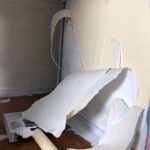

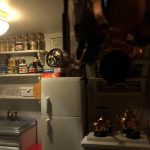




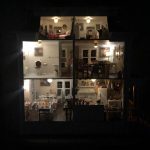
MG: In my first book, we briefly encounter a tea house, the place where my traveling dressmaker lives for a while and makes a needle lace wedding dress. In my second book, her daughter returns to the tea house, works there for a time, and we begin to see it a little more fully. But now, in my third book, Fit Into Me, the tea house is front and center. To this end, I actually spent this past summer renovating an antique three-story dollhouse—taking down wallpaper, repainting both the interior and exterior, laying tiny handcut floorboards, and furnishing with 1:12 scale furniture from dozens of miniature makers all over the world. For instance, there’s raw honeycomb in my kitchen from a woman in Russia; ceramic serving dishes from Thailand; battery operated chandeliers, sconces, and coach lanterns from the UK. I now have the material representation of my fictional tea house on my dining room table, but as of this moment I don’t exactly know why or what I’m to actually do with it. One installation idea I’m particularly interested in is projecting photographs onto the walls and just watching people walk in and out of the rooms? At this point, I’m open to any ideas or collaborative projects other people might have.
KMD: You are a tireless champion of other writers within the literary community. What are the greatest rewards of literary citizenship?
MG: Honestly? Just discovering new voices. Lately, I’ve been thinking of starting an online journal open only to writers who have never published. Also, I’m partial to publishing authors’ first books. My favorite day of the entire editing and publishing process—from reading submissions to selling out of a first print run—is the day my authors receive that box in the mail with copies of their book. I remember the day I unboxed mine, and I’ll never forget it. I want to give that day to others. For the last few years, though, as I finished up my PhD coursework and studied for exams, I had to take a step back. But now, in my dissertation year, I’m itching to return. And I’m not sure if Lit Pub is where my heart is these days. I think it’s had a great run—it’s nearly a decade old now—and that it can serve in a productive way in the future as a student-run reviews publication and possibly also a year-long book production site, but I think, personally, I’m ready for something new.
KMD: What’s next? What events, workshops, and readings can we look forward to?
MG: On October 5, I’ll be the “Intangibles” judge for the Literary Death Match in Ogden, Utah. I’ve judged LDM before, but not the Intangibles—which may be the most fun—so I’m really looking forward to that event. And then a few days later, on October 9, I’ll be reading with Brian Evenson for the City Art Reading Series at the SLC Library downtown. And I might bring the dollhouse for that, if time and venue allows.