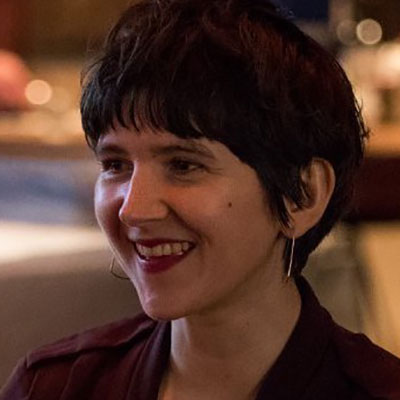
New York, NY: Nightboat Books, 2018. 96 pages. $15.95.
“The poet produces the beautiful by fixing his attention on something real. It is the same with the act of love. To know that this man who is hungry and thirsty really exists as much as I do—that is enough, the rest follows of itself.” —Simone Weil
In 2018, climate change reports forecasting drastic global temperature rises as soon as 2040 come thudding against our digital doorsteps on an ordinary Monday morning. News of what may be the worst famine the world has seen in a century doesn’t even make the front page.[1] In these still-early years of the twenty-first century, millions of people are displaced from their homes annually in what we’ve come to know as the “Global Refugee Crisis,” as well as the more geographically specific “European migrant crisis.” In response to the conditions of our ever more fragile, “precarious” world, reactionary extremist groups and neo-fascist regimes are rising, all over the globe, to stoke and exploit people’s fears and divisions—precisely at a time when compassion and solidarity are most desperately needed and most warranted.
These crises are man-made, and it is (still) in our power to unmake them. When posterity looks back on the twenty-first century, the diagnosis of our greatest failure will be a failure of the imagination. This is why Asiya Wadud’s Crosslight for Youngbird—a book that brings the individual, lyric voice into antiphonal conversation with a chorus of real and imagined speakers from the refugee crisis—is an urgent medicament.
How might one begin to locate the self—necessarily so circumscribed, localized, and particular (or particulate?)—in relation to large-scale events, mass populations, and ongoing global crises? This is a question Wadud’s powerful debut takes up, making it clear that we must find or forge a way. In an early poem in Crosslight, two men, Omar and Martin, share their migration stories:
I am a good swimmer, I’ve always lived by the sea . . . And I am a good swimmer, I’ve always loved the sea. The way its light envelops me. And the manner that it holds my dreams . . . But the long arm of empire, it grips back and we arrive on rotten pallets.
Astonishingly, tragically, in our present day we continue to follow roads carved by ruinous empire, which begrudges the humblest transports, rots a meager life raft, denies passage and safe harbor. Surveying these roads, Wadud hears the call to imagine our way to another way—and she responds.
She gives us youngbird.
Who is youngbird? An elusive figure, but everywhere present. A gymnast, a shape-shifter: “in any language it’s the same: bird is airplane, intertwined.” Youngbird is also Newbird and Everybird—perhaps a kind of Everyman. Youngbird is sometimes she and occasionally I. Both an adult, and a child, a lost loved one. Youngbird is a migrant. She gives us the vantage of the periplum—the voyage out, to the apogee and back—so we can begin to locate ourselves in relation to this world. It is a world with people “all named at birth . . . named on the day they were born. . . . You can say their names,” Wadud intones, in what feels at once plea and command.
What does it mean to urge this fact? To ask that names be recalled, as they were once called, recited as they were once commended? What is the mode of this address? “Absolutely unmixed attention is prayer,” writes the philosopher Simone Weil in an essay from Gravity and Grace;[2] “Extreme attention is what constitutes the creative faculty in man and the only extreme attention is religious.” Wadud is a poet of this kind of prayer. Crosslight for Youngbird teaches an art of attention as supplication.
In the poem that opens the second part of the book, salt carrion constellation, titled “young warblers, golden plovers, loons”—a poem so deeply vulnerable that it’s openness is an edge that cuts—Wadud writes: “Doom is walking on your own two feet towards a clean expanse. Resolve is the ready supplication, a pilgrimage to a church on your knees.” Attention and resolve. These are acts of devotion in which “the ‘I’ disappears,” opening onto “that which cannot be conceived” (Weil, 118). This is the root of poetry, of poiesis, of creative making. It can make of each of us a migrant, a pilgrim, a supplicant.
now touch the sky with two arms
now touch the sky with two arms(“still life on lesbos”)
Crosslight for Youngbird invites us to soften the borders of our fortified “I,” to relax a little and reach out, perhaps to “touch the sky with two arms,” or to grasp another’s arm. Or, rather, to hold without grasping, and to allow oneself to be held in turn, even in something as vast and unknowable as the ocean. To be held by that, to be “bobbing creatures amniotic salted”, and thus to be freed—to “a keen wild and / a coming liberation.”
“Doom and resolve each keep their own metronome,” Wadud writes in “young warblers, golden plovers, loons.” Their syncopation can be felt throughout. In this most difficult of poems, which brings us into the visceral experience of losing an unborn child, recalling both Gwendolyn Brooks’s “The Mother” and Anne Bradstreet’s “Before the Birth of One of Her Children,” Wadud holds doom and resolve, love and wretchedness (in Weil’s terms), in a tense, fluid equilibrium:
I swallow hard and festoon myself against a sliver of certain doom. Of course the baby has no heartbeat. Little bear, you spent 77 days with your own black thoughts, chasing a scythe, a sickle, a sepulcher, a sentry. You spent all those days chasing your own slippery tail, fishing for carrion.
[ . . . ]
Doom is the night that does not break at the day’s dawn. Resolve is the daylight as it does not cease; the light transfigurates and bends, yes, but the daylight does not break. I hold these fecund twins.
The poem holds it all, stretching our powers of imagination, training our attention, strengthening our resolve—even and especially when it comes to those things that are hardest to contemplate. (“Sin,” writes Weil, “is nothing else but the failure to recognize human wretchedness. . . . Purity is the power to contemplate defilement.”)
In an age of attenuated imagination, of diminished attention, Crosslight for Youngbird might be a lifeline—offering a kind of spiritual transfusion for the weary, the boxed-in, the blinded. Wadud’s poems restore sense to those regions of ourselves that have been numbed by privilege, which under capitalism and (neo)colonialism is only ever the temporary and partial suspension of a deeper oppression. Crosslight turns all its voltage on this relationship between the privilege we may mistake for freedom and the oppression it is in fact.
My New Oxford American Dictionary defines “crosslight” as “a light positioned to illuminate the parts of a photographic subject which the main lighting leaves in shade.” Likewise, Wadud irradiates the obscured in our world with her unflinching attention and capacious imagination. In the illumination of these poems, our vision extends into further reaches. In the last poem of the collection, “a dinghy,” Youngbird voyages out—far out on “the crystalline sea”—not into transcendence, but further into the fold, the “sharp fold / that says it’s the sun,” To those of us still standing on the shore, nervously toeing the water’s edge, she calls out to us to set aside our fears. I hear this call as, at once, provocation and benediction:
“I’m not sinking I’m floating.”
Notes
[1] Hannah Summers, “Yemen on brink of ‘world’s worst famine in 100 years’ if war continues,” The Guardian, Oct. 15, 2018, https://www.theguardian.com/global-development/2018/oct/15/yemen-on-brink-worst-famine-100-years-un.
[2] Simone Weil, “Attention and Will,” Gravity and Grace, trans. Emma Crawford and Mario von der Ruhr (New York: Routledge Classics, 2003): 116-122.