

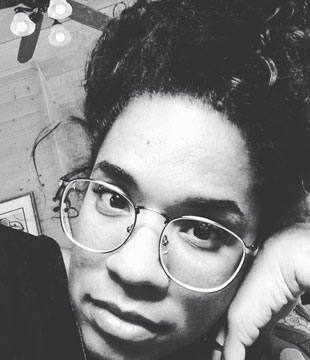
 Nikki Wallschlaeger’s work has been featured or is forthcoming in Nation, Georgia Review, Brick, Witness, American Poetry Review, POETRY, and others. She is the author of the full-length collections Houses (Horseless Press, 2015) and Crawlspace (Bloof, 2017), as well as the graphic chapbook I Hate Telling You How I Really Feel (Bloof Books, 2016). She lives in the Driftless region of Wisconsin with her family. Her poem “William Carlos Williams” can be found here. It appears in the Sept/Oct 2019 issue of the Kenyon Review.
What was your original impetus for writing “William Carlos Williams”?
Well, WCW’s famous poem “This is Just to Say” is riffed on dozens of times on the internet. I’d love to see someone edit an anthology on the evolution of this poem. “The Red Wheelbarrow” had its turn, but not as much. So the two most popularized WCW poems are alive and circulating in social media—they have gone beyond poetry to a kind of public template, and it’s interesting to see what people do with these poems. I have no idea what WCW would think. Perhaps he would be flattered, it would be fun if someone hosted a séance to ask him. Instead of using “This is Just to Say,” I decided to use “The Red Wheelbarrow” and subvert the entire poem, to a point of suggesting maybe this wasn’t even his own idea. In the poem a Black woman muse from the spirit world whispered a secret in his ear because she thought he was kind of cute, walking on a road one day. Maybe some readers will think this is farfetched, but maybe that’s the problem. Modern society isn’t interested in muses and spirit realms except as sources for entertainment, much less the idea of a Black woman muse ascending to an ancestor otherworld, relieved from a life of oppression and labor during her mortal sentence on Earth.
In this poem, the sky agrees to hold up a constellation in honor of Black womanhood “since the labor it took to live down here can never be repaid. But most people recognize it as a constellation called the ‘Big Dipper.’” Could you share more about the labor in this poem, and your decision to honor it in the stars?
The Big Dipper was one of the first constellations I learned along with the Little Dipper and Orion the Hunter. Every year in elementary school we would take a class field trip to the small planetarium at the high school, and it was a highlight of the year for me. Many cultures throughout time had their own myths about this constellation, indigenous cultures associated it with a bear, the ancient Romans saw it as a plough, and enslaved Black people used it to find their way out of the slaveholding territories in the underground railroad as a guide to freedom. It’s a constellation that has many interpretations across many cultures throughout human history. Like clouds in the sky during the day where you can sometimes pick out shifting shapes, the night sky invites the same possibility of myth and imagination. My spouse picked up several small wagons used for gardening and outdoor work, so this was at the back of my mind when I was out stargazing and had thought it looked more like a wagon than a large spoon used for transporting water. A wagon turned over, a symbol of labor overturned, women at rest from domestic work. As far as I know, at least in the West, there are no constellations honoring Black women’s work, during the time of our enslavement or as members of a family’s daily survival. They are important and useful tools, they carry wood for kindling, crops for meals, etc. They transport building materials and can save you a lot of time when you’re doing yard work. In this age they are regarded as antique, primitive, an object of the past. But how the past was built affects the future, and you can’t have a future without the tools of the past, so I have an appreciation for the old technologies people use to improve their labor conditions of working directly with the earth without automation and modern mechanical engineering. I’m not a Luddite, but the relationships we have with the soil—when you are engaged with it by your own hands—there’s a satisfaction you can’t get anywhere else, even if the labor is long and difficult. Obviously if you are forced to work the land the relationship changes, the work you do for somebody else’s survival when your own needs are not being met, like enslavement or low pay. I want to honor Black women’s working lives. What better way than to (re)imagine myths and stories to suit our histories? Stars, above our planet, where the labor on earth has been released, overturned, and subverted. The sky does not have one official cultural meaning and this is clear in studies of myth and mythmaking across human civilizations.
Which non-writing-related aspect of your life most influences your writing?
Like WCW, I also find meaning in objects; he was the first poet to teach me this, so even though “William Carlos Williams” is a subversion of “The Red Wheelbarrow,” it’s also an homage to his idea of finding meaning in objects, and depending on what is found in them to be worthy of a poem, to make readers look again at something they may not have noticed before. For instance, I love going to thrift shops, flea markets, garage sales, the nature of these spaces resists hegemony even if many of the objects sold in them reinforce American officialdoms I can do without; at any rate, they are hegemony’s cast-offs reflecting the trends of prior economic and cultural hegemonies. Irony fills the landfills, and seas, having the last sardonic laugh as our omnipotent ruler of toxicity. I’ve written list poems comprised of objects from my childhood, the names of designer chairs, and biological forms. Objects are great at creating the tone of a poetic environment when the urgency driving the poem asks to be hidden like a missing price tag.
What project(s) are you working on now, or next?
Last spring I finished my third book, titled Waterbaby, the collection “William Carlos Williams” will be a part of. It’s currently in circulation, so I’m in waiting mode right now. It’s a book primarily focused on grief + blues and the element I associate with “lowness,” as Natalie Shapero so aptly put it in the introduction to the Sept/Oct issue of the Kenyon Review. The element I associate with blue living and feeling bad is water, so a lot of the poems are about human relationships with what we can’t live without. In the meantime, I started another book! It’s called Hold Yr Own. This one will be about finding strength, developing new roots, and the growth that comes with it, whether it be painful, liberating, or just plain terrifying. When I began this book my intention was to be a post-grief book because while I was writing Waterbaby I experienced the death of one of the most important people in my life. Naïvely, I thought I put the pain behind me, but that’s not the way grief works. So in Hold Yr Own, there’s still a lot of grief, but I’m trying to own it, to accept it, and mature from it. I have a poem coming out in the October issue of Poetry that’s coming from this collection called “The Coyote Killers”—it’s about a country bar not far from where I live that hosts an annual killing contest of who can murder the most coyotes and crows in the region. The animals lost their lives for no reason other than to support someone’s ego, but they still come back, at least for now, often stronger than before, with new stories to tell.