Carbondale, IL: Southern Illinois University Press, 2018. $15.95.
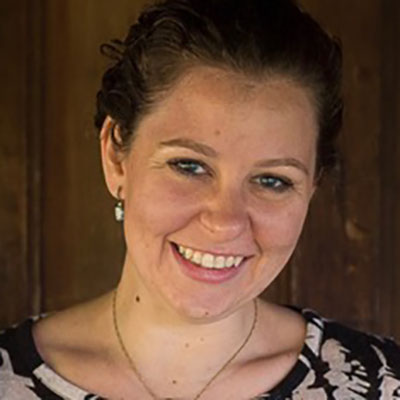
Kara van de Graaf’s Spitting Image is a collection that lives in the tension between the self and the body. The collection opens with a poem about distance and seeing, and situates the reader in the poet’s world. In an intimate setting—a kitchen—the reader is eavesdropping on a private and strained moment between a couple. The first poem’s refrain, “Things keep happening,” sets up a collection that will focus on what is often invisible or excluded. The poet will focus on what is anything but passive or taken for granted, will illuminate and focus on what’s long been relegated to the background. As she opens the collection, van de Graaf leaves the reader with a final image of potatoes as eyes—attuned and aware.
There is so much beauty in the frankness of the language. Van de Graaf writes about topics we—women, heavier women in particular—have been shamed out of talking or writing about. But these are poems that are honest in their probing of why that is and what happens to the person afterward, a person who has been dismissed because of her body. There is strength here, too, in the poems and the voice of the poet, whose clarity cuts her reader open.
What is telling, particularly through epigraphs and notes on the poems, is where and how this type of body has existed (or is allowed to exist). Based on a 1860 painting of the same name by Juan Carreño de Miranda of Eugenia Martínez Vallejo, “La Monstrua Vestida” begins with a sensitive description of a young girl. With this approach, van de Graaf’s empathy for the subject emphasizes the spectacle the artist has made her into on canvas. The speaker, seeing herself in this caricature, imagines this portrait as a foil for the ladies at court. In comparison to an obese child compared to an adult man and various animals—anything but who she is—they see themselves as “closer to perfection.” She writes,
Only six but she weighs as much
as a full-grown man. Round-bellied,surly, she is part of a collection
of anomalies, like a pug-faced
dog or a dwarf, a yellow-crownedparrot, its throat such vivid orange
the court had never seen it before.
In this museum, too, she is an anomaly,a body I half-recognize as my own,
a familiar I project horror onto
like a mother.
In this way, there is also an interplay of gender and species. To find the right entrance into a poem about a young adult female body in the present day, the poet has to look elsewhere—through time and space, into art and science, to animals and men. In this poem, it is clear just how rare it is to find this body, or this kind of body depicted compassionately and humanely.
When the poet does seek to examine her body in the present day, as in “The Doubles,” it is distorted by mirrors. Set in a department store changing room, van de Graaf imagines each reflection the speaker sees as the multiple versions of her body she’s been. Body parts are described as if they’re independent of the poet; reflections are as real as the person in front of the mirror.
Their hips
lurching out of drywall. Their breasts
swelling against the concrete floor.
I congratulate one on her thin legs.
And yet the poem is about more than a mirror’s reflection: rather, the different women one woman can be as she ages and changes size, that it will never end. Any woman who has complete wardrobes in multiple sizes will certainly find resonance here, a simultaneous disassociation and ownership of the person you are in those various sizes and outfits.
The job of a poet, I believe, is to make the reader reconsider something they think they know. Throughout Spitting Image, even as the poet focuses her gaze elsewhere, the reader is constantly reconsidering the female body, particularly a problematic or challenging female body, and how it fits into the poet’s world and the larger world. The body she writes about is one that finds itself at the center of attention for unflattering reasons, or it is otherwise invisible. This is the body she, as she says in “Sonnet With a Wishbone in the Throat,” “kaleidoscopes” the reader’s focus on.
When I speak, each phrase kaleidoscopes,
modifies, a duet of whispers I lip into air.
I sound sweet when I want to be bitter.
She does this through the collection, by turning language just a little bit. This, for me as a reader, is how the book pivots. The language is accessible; the syntax is accessible. And yet the poet conjugates certain nouns as verbs to set in motion such an image that turns the poem on its side. The effect is a world that feels deeply normal and yet a surreal undercurrent runs through it. The poet is a trustworthy guide through her world; her attention to detail is exquisite. And you need her, you need her to show you where to look and what to see once you’ve focused. The surreality is haunting in its subtlety and specificity. The reader strives to find each metaphor literal, as if in “Sonnet With a Wishbone in the Throat,” the poet’s windpipe will actually split and take the shape of a wishbone, as if the voice box will actually “grow into an echo chamber.” The images and sentences are so precise the reader feels completely at home in the world of the poet.
In some ways it seems as though, to write about this kind of body, one that has been excluded from this kind of conversation, the poet has to make comparisons to everything else—from an overweight child in a seventeenth-century Spanish painting, to Einstein, to the whale at the Museum of Natural History. Van de Graaf finds energy and pain in these comparisons, a way to examine large things around her, and substitute emotions that have been stifled and suppressed, either by the poet or by societal norms, or both. This collection is radical in its intimacy.