

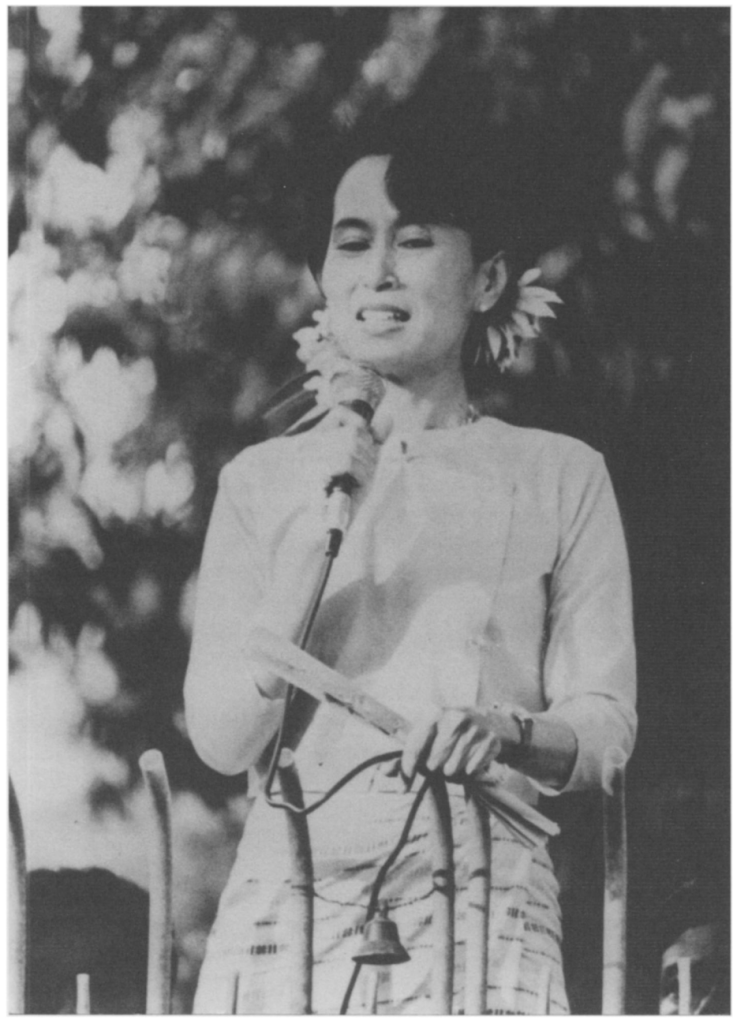
Aung San Suu Kyi’s childhood home is a dilapidated, once-handsome bungalow that looks out on Rangoon’s Inya Lake—a picturesque tretch of water whose surface is dotted with water lilies and whose shores are lined with walled villas and manicured lawns. University Avenue is wide, quiet, and tranquil, shaded by some of the majestic flowering trees for which Burma is justly famous. Rangoon University, after which the roadway is named, is not far away. It was there that Suu Kyi’s father, Aung San—modern Burma’s national hero—first rose to fame as a student leader, in the early thirties. It was there, too, that the mass uprisings of 1987-88—the protests that came to be known as the democracy movement—had their beginning. It was because of Aung San’s iconic role in Burma’s anticolonial struggle that Aung San Suu Kyi had the mantle of leadership thrust upon her during the agitations of 1988. By a curious irony, the dictator against whom the democracy movement was principally directed, General Ne Win, also happens to live on the shores of Inya Lake, a short distance from 54 University Avenue. Although the general was forced out of power in 1988, many Burmese believe that his hands still lie heavy on the reins of power, even now. Thus they stand, the two opposed poles of Burma’s political circuitry—the crazed general and the unyielding democrat—separated by a single stretch of water: it is as though the country’s tormented history had been etched upon the waxy surface of a lily pad.
