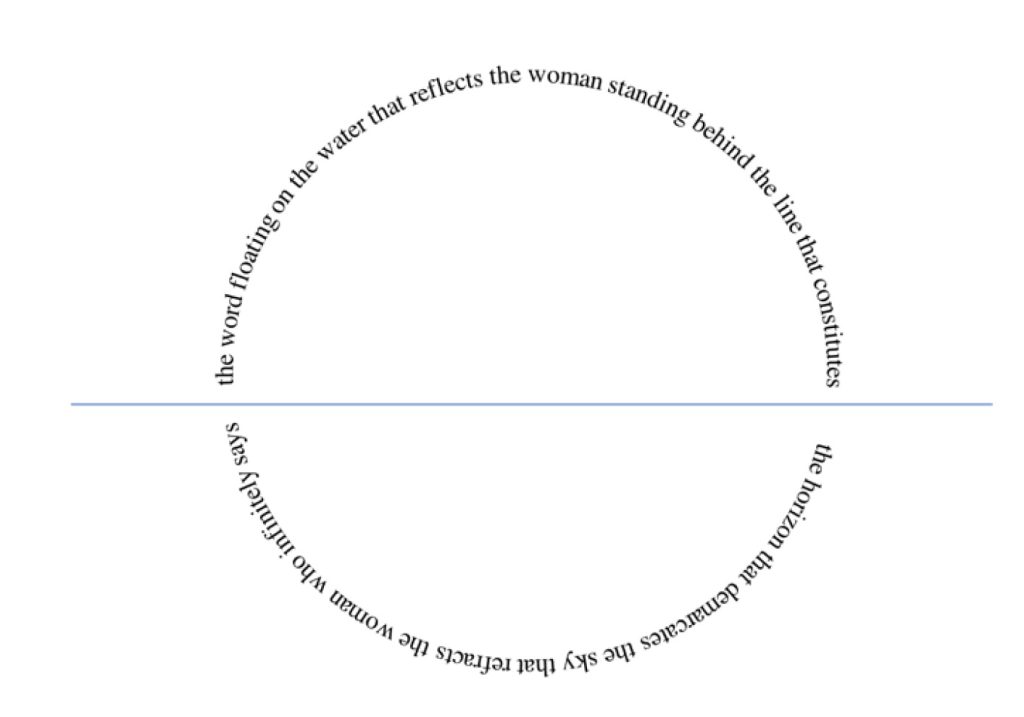
You enter my eye as if willingly, a flesh-filled hologram, acids and enzymes teething on your figure’s edge.


Satellite, illusory bird’s-eye view: circling, bright bite through the dark window, desiring a wholeness that fits inside the frame.


Seduced by the looking, I stand uncomfortable and wet in the afterthought.


To reach Magritte’s Le Séducteur, housed in the Virginia Museum of Fine Arts (1936), I walk past the Memorial Building of the Daughters of the Confederacy (1957) and the statue Rumors of War by Kehinde Wiley (2019) and into the museum, where someone asks to take my umbrella because over all this it has rained.


Translation 1

 — determiner, particular, points forward — after the transcription point, from where it sprang (what is it?) — or if it is particular to a subject or engineered — (is it an error or an intention?) — such as a dam (of wood, concrete, or a missing synapse) — coated in saliva, some aspects absorbed into the bloodstream and others circulated through the gut and evacuated — “expressing the relationship” — a “moon, planet, or machine” that captures the image, rats out the light — in language is it a full bleed, still bleeding, or clotted — present, perfect, continuous — it finds a solution flowing out . . .


What is upstream?

	thought from gut
	parent from child
	word from sentence
	vocal cord from anvil and stirrup
	question from answer
	exterior from interior
	apartment from landfill
	war from weapon
	goldfish from carp
	oil well from gas tank
	field from farm
	collective from individual
	slaughter from meat

	Vapors, then a reversal of rain.


Magritte: “I have been looking for some time for a pictorial solution to the problem of water.”


Any other decisions take place in the corridor that leads to the museum bathroom.


In a reawakening of the image, “many phytoplankton ecologists appear to have recovered from the seduction in the 1960s and ’70s by fluorometers, liquid scintillators, and electronic particle counters, and returned to microscopes.”


André Breton, from Fata Morgana: “It makes me think of an object I cherish . . . Which before seducing me had to serve (it doesn’t matter) some necessity of commercial representation.”


I’ve been looking for some time for the linguistic solution to the problem of water.


The object hides beneath the horizon line but is refracted in clouds. “Housed in” means well lit, secured to a wall, a rope or taped line on the floor. The restriction is end-stopped.


While I’m standing in front of the painting, several of my cells commit apoptosis in time with the collapse of a far-off star. A docent drifts by to tell me not to keep my body this close to the art.


The woman in the apartment is a refraction of the world below the horizon. She ascends like light trapped in water trapped in sky. She eats brown-hued lettuce, and the wallpaper reminds her of the drying skin that splinters from her fingernail beds.


And reality? The woman in her apartment or the woman in front of a painting called Le Séducteur inside a building next to Rumors of War by Kehinde Wiley next to the Memorial Building of the Daughters of the Confederacy?


When the real lies below the horizon, the clouds refract it in little pieces of light tethered to molecules that seek out, then die on the surface of the eye. The real has the appearance of floating in the sky, transformed by a thermal inversion into an infinite regression. The infinite regression in the sky without acknowledgment of the object below the horizon line is sometimes called history. The sky does not mean the same thing as water, but they are part of the same problem — the problem is incomplete without them.